Protected Cultivation & Fertigation
Micronutrient Management in Greenhouse Tomato (Saudi Arabia)
In hot-climate greenhouse tomato production, effective micronutrient management depends on root-zone pH and EC, irrigation-water quality, accurate fertigation, and crop-stage monitoring—not simply on adding more fertilizer.

How should micronutrients be managed in greenhouse tomatoes in Saudi Arabia?
Micronutrients in hot-climate greenhouse tomato production should be managed as part of the complete water, root-zone, and fertigation system. Effective management means keeping the right nutrients available at appropriate concentrations and crop stages while monitoring irrigation-water quality, root-zone pH and electrical conductivity (EC), drainage, and plant response. Adding more fertilizer is not the first or only answer when a deficiency is suspected.
This guide applies to greenhouse tomato production under Saudi Arabia’s hot-climate conditions. Exact nutrient targets and corrective actions still depend on the production system, irrigation water, soil or substrate, cultivar, crop stage, and analytical results. Use the guidance as a framework for monitoring and diagnosis, then confirm specific programs with qualified local agronomic advice.
Why do hot climates make tomato nutrition more challenging?
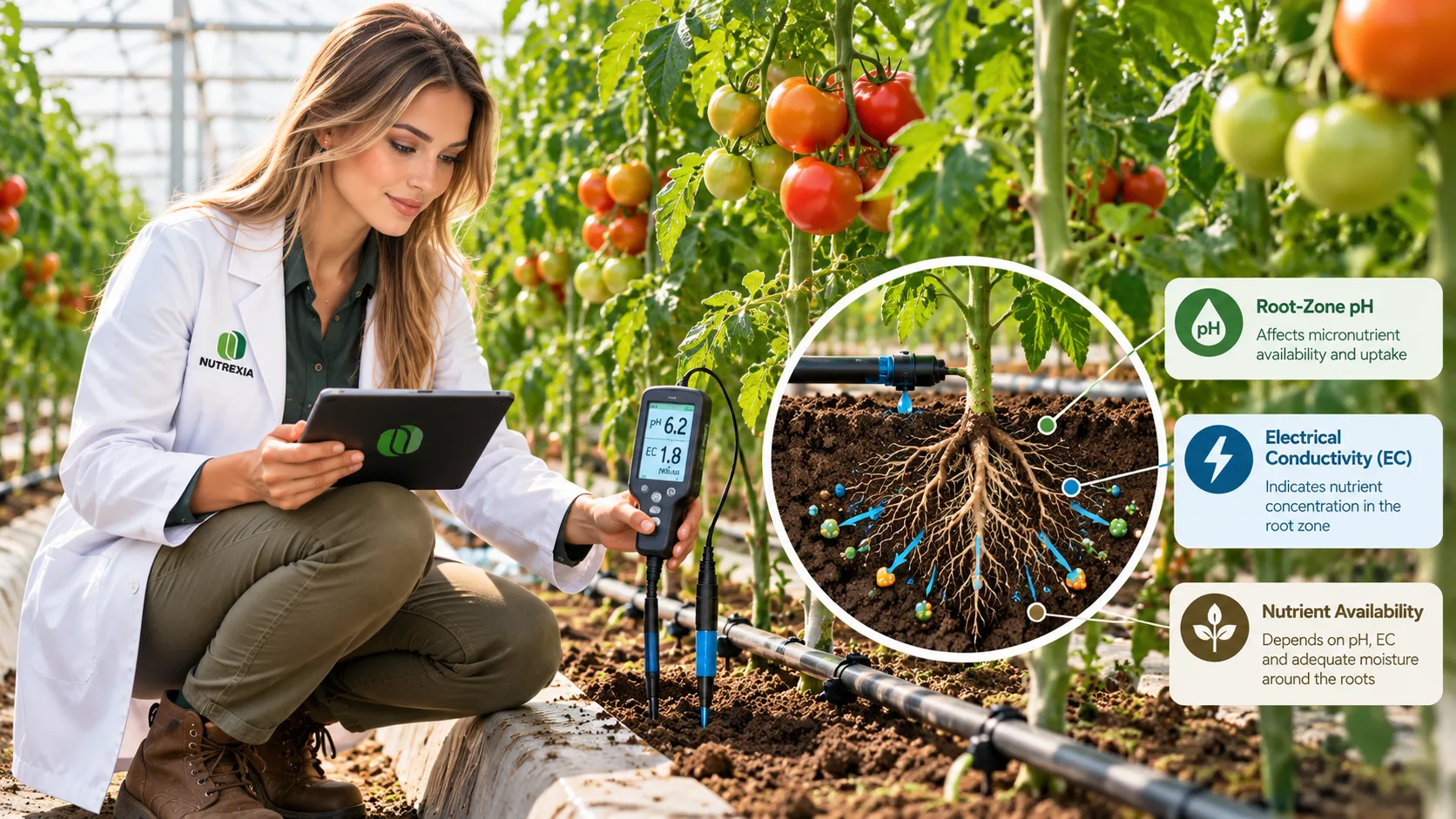
High temperatures can increase crop water demand and change irrigation frequency. More frequent irrigation may be necessary, but irrigation alone does not guarantee good nutrient uptake. The root zone still needs suitable moisture, aeration, pH, and EC, while irrigation-water chemistry can alter the nutrient environment.
Micronutrients are required in small quantities, yet they participate in processes that support photosynthesis, enzyme activity, growth, flowering, and fruit development. A small supply requirement should not be confused with small agronomic importance.
Why does irrigation-water quality matter?
Before building or adjusting a greenhouse tomato nutrition program, understand the irrigation water. Relevant measurements include pH and EC and, where appropriate, alkalinity or bicarbonate, sodium, and chloride. Water chemistry can affect the root-zone environment and the availability of several nutrients.
Why does root-zone pH matter?
Nutrients must not only be present; they must be available in forms that roots can take up. Root-zone pH is therefore an important part of managing iron, manganese, zinc, copper, and other micronutrients.
When a deficiency is suspected, do not immediately assume the fertilizer dose is too low. First determine whether the nutrient is available and whether root-zone conditions support uptake.
Which micronutrients are important in greenhouse tomato production?
Iron (Fe)
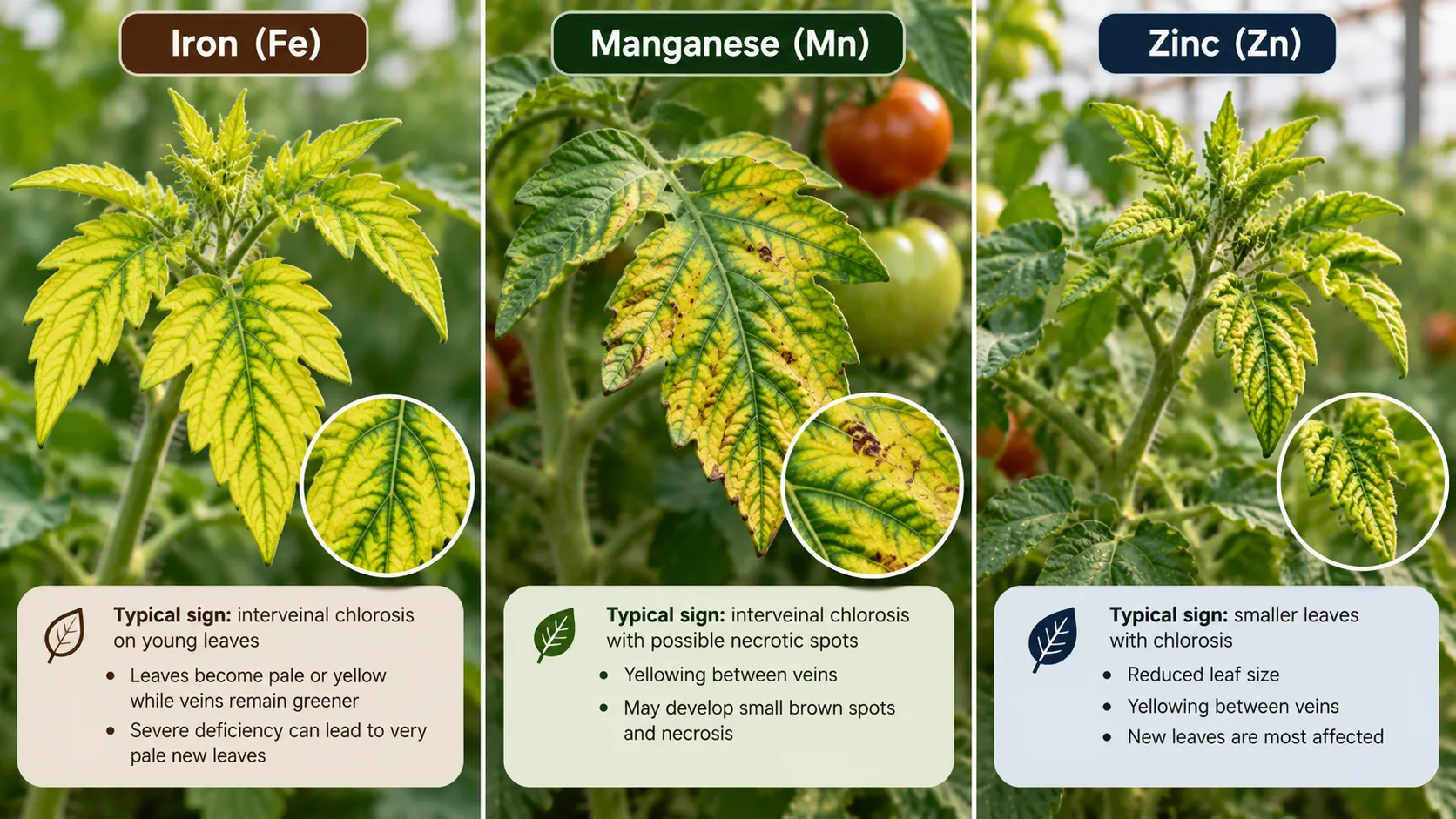
Iron is closely associated with healthy photosynthetic activity and green-tissue development. In tomato, deficiency begins with interveinal chlorosis and can progress toward widespread yellowing of the leaf blade. Severe deficiency can cause new leaves to become very pale or white, with necrotic spots appearing.
- Check root-zone conditions and pH when iron deficiency is suspected.
- Use an iron source appropriate for the production system and water and root-zone conditions.
- Do not diagnose every yellow leaf as iron deficiency; confirm the symptom pattern and use tissue and root-zone information where possible.
Manganese (Mn)
Manganese supports plant metabolic and photosynthetic processes. Deficiency can resemble iron deficiency because interveinal chlorosis may develop. Other reported symptoms include poor bud development, wilting and yellowing, and necrosis between the veins.
- Compare symptom location and progression with iron deficiency.
- Review pH and root-zone conditions before changing the micronutrient dose.
- Use tissue or solution analysis when visual symptoms are unclear.
Zinc (Zn)
Zinc contributes to normal enzyme activity and plant growth. Deficiency symptoms can resemble iron deficiency and may be particularly noticeable on smaller leaves.
- Avoid treating zinc deficiency from appearance alone.
- Review the complete nutrient program rather than correcting zinc in isolation.
- Confirm a suspected deficiency with crop and root-zone information whenever possible.
The following visual compares common iron, manganese, and zinc symptom patterns. It is an orientation aid, not a substitute for systematic diagnosis.
Boron (B)
Boron is important around actively growing tissues and is closely connected with reproductive and structural development. Reported deficiency symptoms include chlorosis and brown spots around the growing tip, drying and withering of affected tissue, stem cracking, and small fissures on fruit.
- Pay particular attention to growing points and reproductive development.
- Remember that boron has a narrow practical range between insufficient and excessive supply.
- Avoid routine high-dose applications without a clear nutritional basis.
Copper (Cu)
Copper is required in very small quantities and participates in plant enzyme systems and other physiological processes. Deficiency in tomato can appear as yellow and brown spots on leaves.
- Because the crop requirement is small, diagnosis and dose control are especially important.
- Consider the complete nutrient solution and root-zone conditions before adding copper separately.
- Use analysis when symptoms are ambiguous.
Molybdenum (Mo)
Molybdenum is required in very small quantities and is involved in nitrogen metabolism. Reported deficiency symptoms include interveinal chlorotic spots, sometimes with a cup-shaped appearance. Severe symptoms can extend toward lower parts of the plant.
- Treat molybdenum as part of a balanced micronutrient program.
- Do not assume visible nitrogen-related problems will automatically be solved by increasing nitrogen.
- Use plant and root-zone information to distinguish nutritional causes.
How can micronutrient deficiency be diagnosed more reliably?
Visual symptoms are useful signals, but several deficiencies can look similar. Root stress, water management, salinity, and other environmental conditions can also influence the same symptoms. Use a diagnostic sequence:
- Identify where symptoms appear: older leaves, young leaves, growing points, flowers, or fruit.
- Describe the symptom: interveinal chlorosis, marginal damage, necrosis, distorted growth, cracking, or poor development.
- Check root-zone pH, EC, moisture, drainage, and irrigation uniformity.
- Check irrigation-water EC, pH, and relevant salts or alkalinity.
- Confirm with water, nutrient-solution, or plant-tissue analysis where possible.
Diagnosis should establish both the symptom and the conditions that created it. This helps avoid a corrective application that raises nutrient concentration without solving the underlying availability or root-zone problem.
How does fertigation improve micronutrient delivery?
Fertigation allows nutrients to be supplied with irrigation in frequent, controlled applications. It also makes injector calibration, stock-solution preparation, compatibility, concentration, and irrigation management part of the nutrition program.
- Calibrate injection equipment and verify that the intended concentration is being delivered.
- Monitor root-zone pH and EC rather than relying only on the fertilizer recipe.
- Consider irrigation-water chemistry when selecting and adjusting the nutrient program.
- Check compatibility when preparing concentrated fertilizer stock solutions because incompatible materials can precipitate and reduce nutrient delivery.
- Use crop stage and plant response to refine the program instead of making large corrective changes from one observation.
Specific rates are intentionally not provided here because they depend on the fertilizer analysis, water chemistry, crop stage, production system, and verified analytical results.
How should micronutrient monitoring change through the crop cycle?
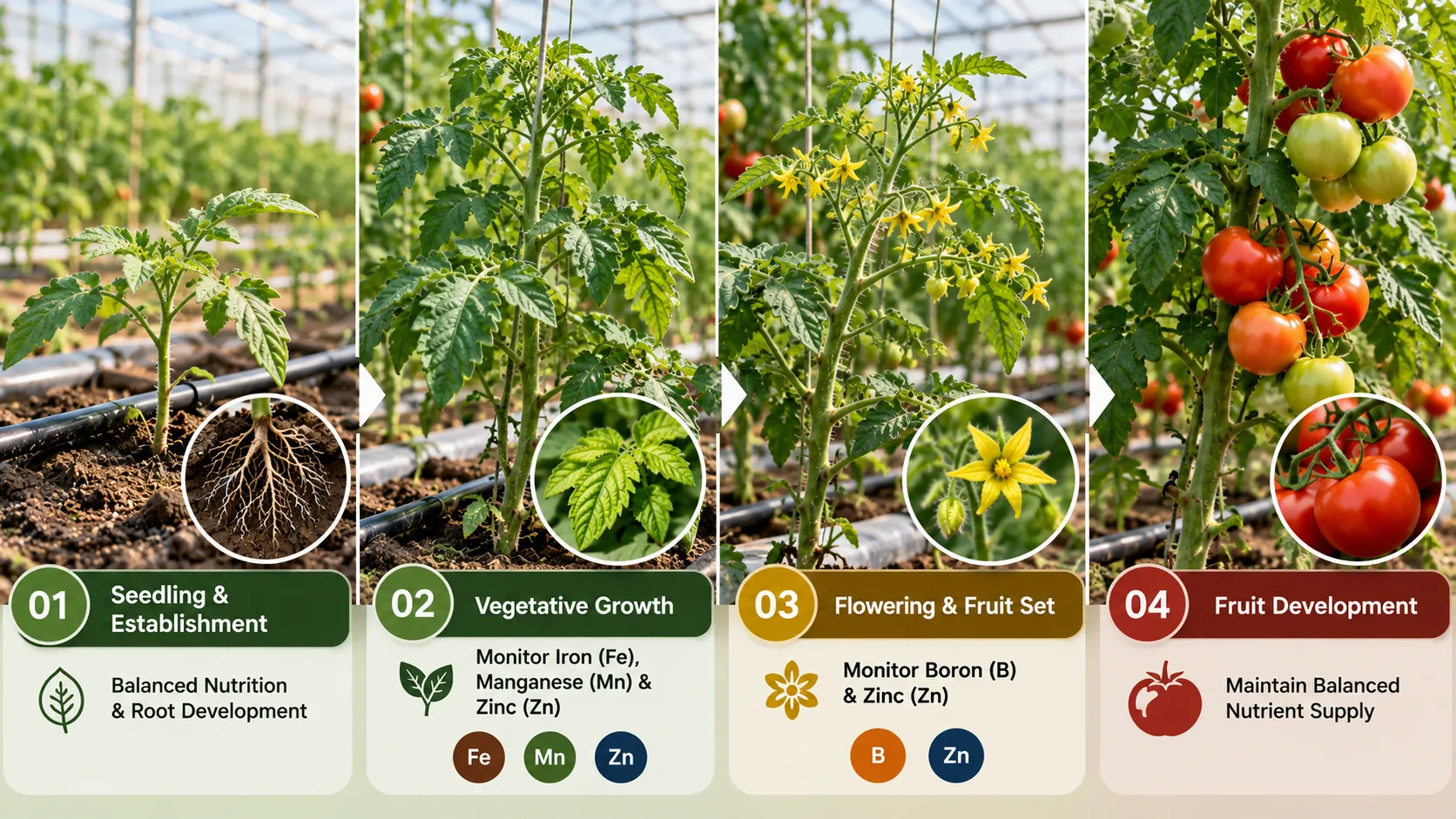
Seedling and establishment
Prioritize a balanced, moderate nutrient environment and healthy root development. Avoid excessive concentration while plants are small and sensitive.
Vegetative growth
Monitor young and actively growing tissue, with particular attention to iron, manganese, and zinc status and the root-zone conditions controlling their availability.
Flowering and fruit set
Pay close attention to reproductive development and the supply of boron and zinc. Maintain balanced overall nutrition and avoid large corrective applications without diagnosis.
Fruit development
Maintain continuity rather than waiting for visible deficiency. Micronutrients work within the wider program of nitrogen, phosphorus, potassium, calcium, magnesium, and sulfur.
Heavy fruit load
Monitor plant and root-zone response closely. Changes in water demand, EC, or irrigation behavior can alter the nutritional environment, so review the program rather than repeating it mechanically.
What should a hot-climate greenhouse tomato checklist include?
Before planting
- Test irrigation water.
- Assess the soil or growing medium where applicable.
- Establish target pH and EC ranges for the production system.
- Check fertigation equipment and injector calibration.
During crop establishment
- Monitor young leaves and root-zone conditions.
- Check irrigation uniformity.
- Watch root-zone EC and moisture.
- Avoid unnecessary micronutrient concentration.
During flowering
- Monitor growing points and reproductive development.
- Pay attention to boron and zinc status.
- Watch the interaction between heat, water demand, and nutrition.
- Avoid large corrective applications without diagnosis.
During fruit development
- Monitor overall nutrient balance.
- Maintain consistent irrigation and nutrient delivery.
- Track EC and plant response.
- Investigate abnormal fruit or leaf symptoms systematically.
What are the most common micronutrient management mistakes?
- Adding micronutrients based only on visual symptoms
- Ignoring irrigation-water quality
- Treating pH as separate from nutrient management
- Increasing fertilizer concentration when the crop is under heat or water stress
- Assuming every yellow leaf represents iron deficiency
- Applying boron without considering the risk of excessive supply
- Using one generic fertilizer program throughout every crop stage
- Failing to check fertigation equipment and injector accuracy
How do water, roots, and nutrients work as one system?
The most useful way to think about greenhouse micronutrient management is as a connected sequence:
Water quality -> root-zone pH and EC -> nutrient availability -> root uptake -> plant tissue status -> flowering and fruit development -> yield and fruit quality
A micronutrient program is most effective when it is integrated with irrigation management, root-zone monitoring, and the crop’s overall nutrient balance. Successful production depends on keeping nutrients available, delivering them at appropriate concentrations and times, and adapting the program to water quality, crop stage, and environmental conditions.
Nutrexia develops fertilizer solutions for practical crop nutrition in modern agriculture. Contact Nutrexia to discuss greenhouse tomato nutrition, fertigation, and micronutrient management for your production conditions.
Frequently asked questions
Which micronutrients are important for greenhouse tomatoes?
Iron, manganese, zinc, boron, copper, and molybdenum all contribute to important plant processes. They are required in small quantities, but their availability and balance still matter throughout establishment, vegetative growth, flowering, fruit set, and fruit development.
Should a grower add more micronutrient fertilizer when tomato leaves turn yellow?
Not automatically. Yellowing can have several nutritional and environmental causes. Check where symptoms occur, then review root-zone pH, EC, moisture, drainage, irrigation uniformity, and water quality before changing the nutrient dose. Confirm with water, nutrient-solution, or tissue analysis where possible.
How do pH and EC affect micronutrient management?
Root-zone pH affects whether micronutrients are available in forms roots can take up, while EC indicates the concentration of soluble salts in the root zone. Both should be interpreted together with moisture, drainage, water chemistry, and crop response.
Which micronutrients need particular attention during flowering and fruit set?
The source guidance highlights boron and zinc during flowering and fruit set, while stressing that they must remain part of a balanced overall nutrition program and should not be applied at high corrective doses without diagnosis.
About the agronomist

Somayeh Soroush
Plant & Horticultural Expert · Nutrexia R&D Specialist
From productive gardens to advanced greenhouse systems, Somayeh Soroush works where practical horticulture meets modern plant nutrition. She supports progressive growers and greenhouse teams across the Middle East, translating Nutrexia's research into clear, field-ready guidance for diverse crops and growing conditions.
Reviewed by: Somayeh Soroush