Regional Agronomy
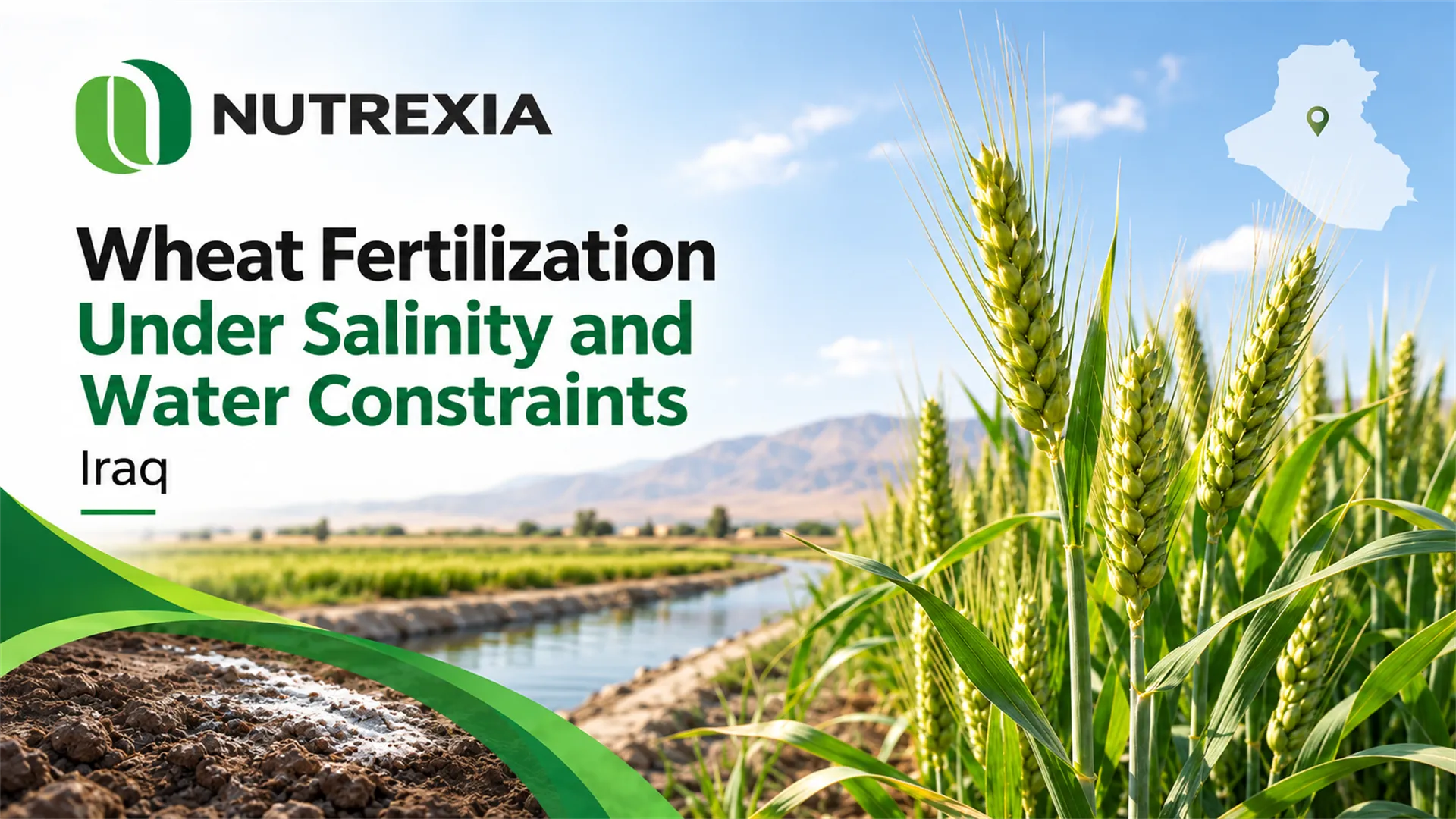
Wheat Fertilization Under Salinity and Water Constraints in Iraq
Wheat fertilization in salt-affected Iraqi fields should connect soil and water testing, realistic yield targets, balanced nutrients, organic matter, irrigation and drainage instead of relying on one standard formula.
How should wheat be fertilized under salinity and water constraints in Iraq?
Wheat fertilization in salt-affected Iraqi fields should begin with soil, irrigation-water and field assessment. Nitrogen must match realistic yield potential and available water; phosphorus, potassium and micronutrients should follow analytical evidence; and every nutrient decision should be coordinated with irrigation and drainage.
This is a decision framework, not a fixed fertilizer prescription. Conditions differ between rain-supported northern production areas and the more irrigation-dependent central and southern regions, while soil texture, salinity, water quality, drainage, variety and season all change the appropriate program.
How do salinity and limited water change wheat nutrition?
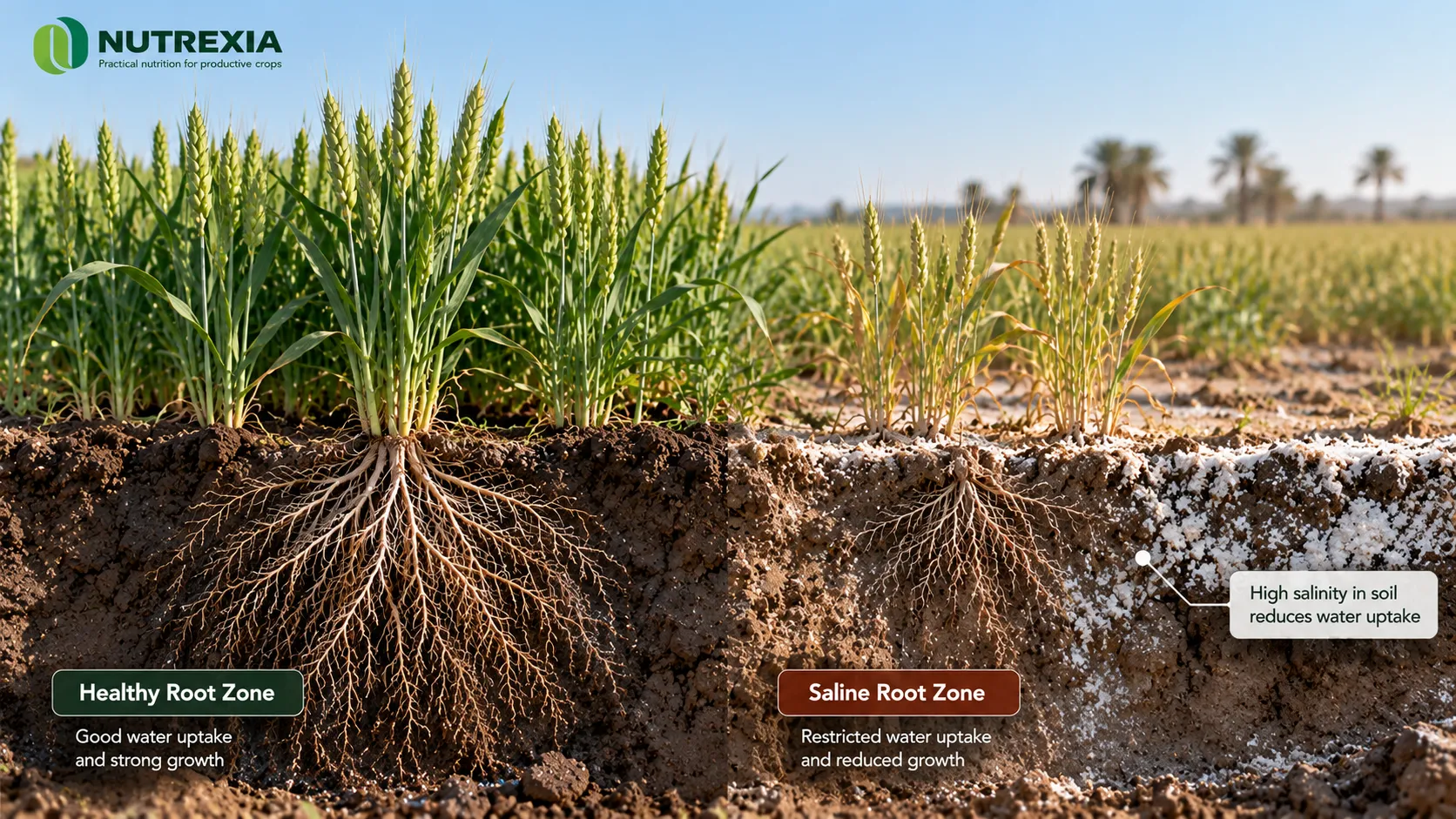
Dissolved salts increase the osmotic pressure of soil water, so roots have more difficulty taking up water even when the soil looks moist. Excess sodium and chloride can also disturb plant metabolism and nutrient balance; sodium, for example, can interfere with potassium acquisition.
The result may be reduced leaf expansion, tillering, photosynthesis, biomass and grain yield. Water scarcity intensifies the stress when too little water is available for crop demand and salt management. Excess irrigation is not a simple solution: where drainage is poor, it can raise the water table, cause waterlogging and worsen salinization.
Before increasing fertilizer, determine whether weak growth is mainly associated with nutrient deficiency, salinity, inadequate moisture, waterlogging, sodicity or several constraints together.
What should be tested before choosing a fertilizer program?
A reliable program starts with diagnosis rather than one formula for every farm.
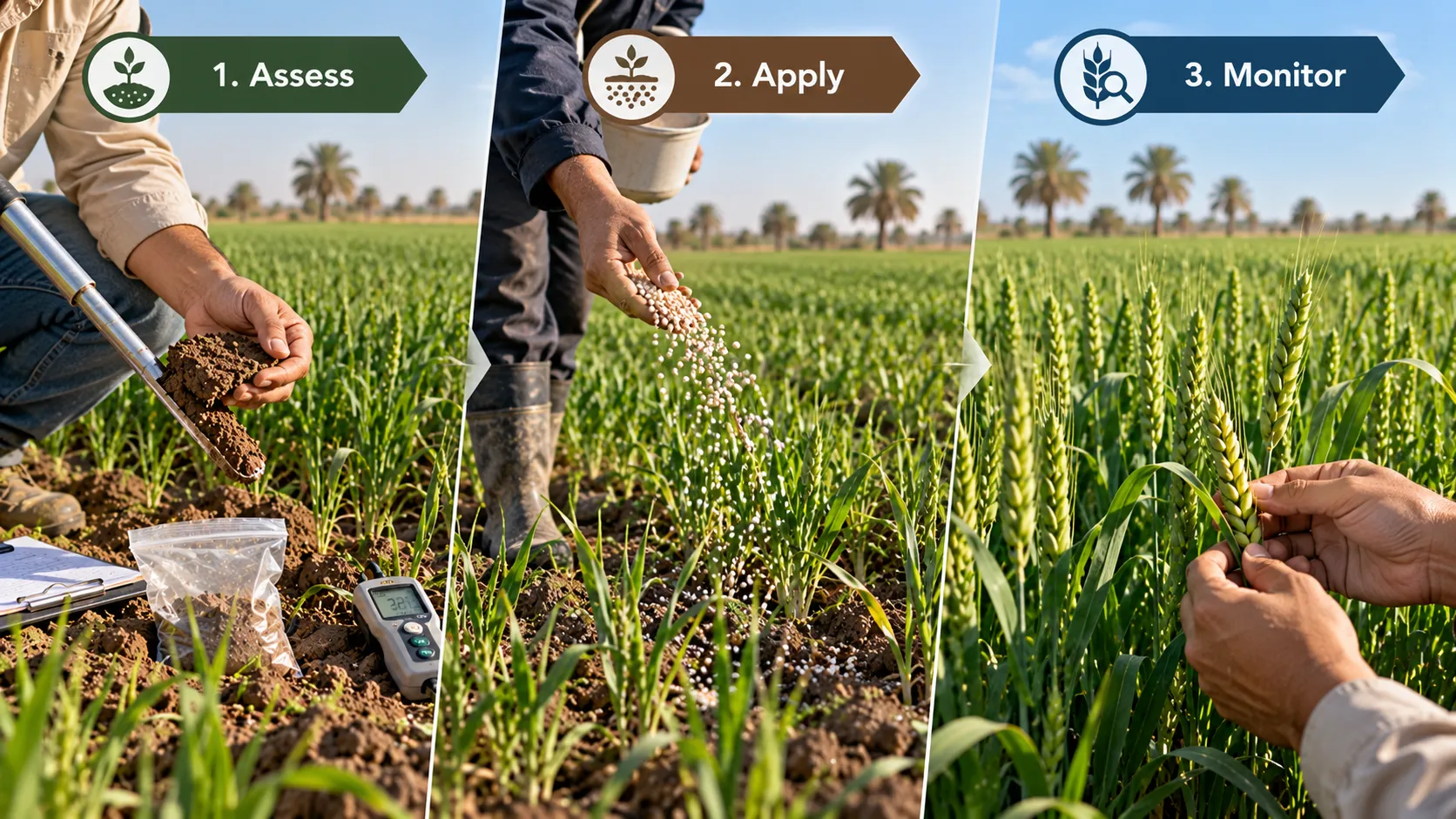
Soil testing
Use representative samples to assess:
- Electrical conductivity (EC) and the measurement method used, including ECe where applicable.
- pH, texture, organic matter or organic carbon.
- Available phosphorus and potassium.
- Mineral nitrogen where testing and local recommendations support its use.
- Sodicity indicators where sodium-related structural problems are suspected.
EC values from different methods are not automatically interchangeable. If salinity varies across the field, sample good and poor zones separately instead of relying only on one composite sample.
Irrigation-water testing
Analyze irrigation water for EC, sodium-related hazards and other relevant quality parameters. Water EC and soil EC are related but are not the same measurement. A workable irrigation strategy depends on the incoming salt load, soil permeability and the field’s capacity to drain salts from the active root zone.
Crop and field history
Record the previous crop, fertilizer and manure use, irrigation method, drainage, rainfall and visible patterns of poor growth. This history helps separate nutrient limitations from problems that fertilizer alone cannot correct.
How should nitrogen be managed when water is limited?
Nitrogen supports leaf development, tillering, chlorophyll, protein formation and grain production, but its value depends on moisture, active roots, crop stage and application timing.
- Set a realistic target. Base the rate on expected yield, soil nitrogen supply, previous crop, local recommendations and the water likely to be available.
- Avoid unnecessary early excess. Supply enough for establishment and tillering without creating a canopy that the available water cannot sustain.
- Consider split applications. Where field access and later water are dependable, divide nitrogen between establishment and a later stage such as tillering or early stem elongation.
- Coordinate with water. Apply nitrogen when the crop can use it and manage water to reduce leaching, volatilization and other loss pathways.
- Reassess after major changes. Drought, weak establishment or reduced yield potential may justify lowering or delaying a later application.
Splitting nitrogen is not automatically better in every field. Its value depends on the soil, source, placement, application method and whether enough later moisture will be available for uptake.
What roles do phosphorus and potassium play?
Phosphorus for establishment
Phosphorus supports energy transfer, root development and early establishment. In alkaline or calcareous soils, reactions with calcium compounds can restrict availability, so soil tests and local recommendations should guide rate and placement. Placing phosphorus near the developing root zone may improve access where soil conditions, equipment and seed safety allow.
Phosphorus can support growth, but it cannot eliminate osmotic stress caused by excess salts.
Potassium for plant function under stress
Potassium contributes to stomatal regulation, enzyme activity, osmotic adjustment and the balance between potassium and sodium in plant tissues. Adequate nutrition matters in saline environments, but adding extra potassium does not guarantee salt tolerance. Confirm a limitation before applying more.
Balance nitrogen, phosphorus and potassium according to crop demand and soil-test results rather than increasing all three simply because a field is saline.
How can organic matter support salt-affected wheat soil?
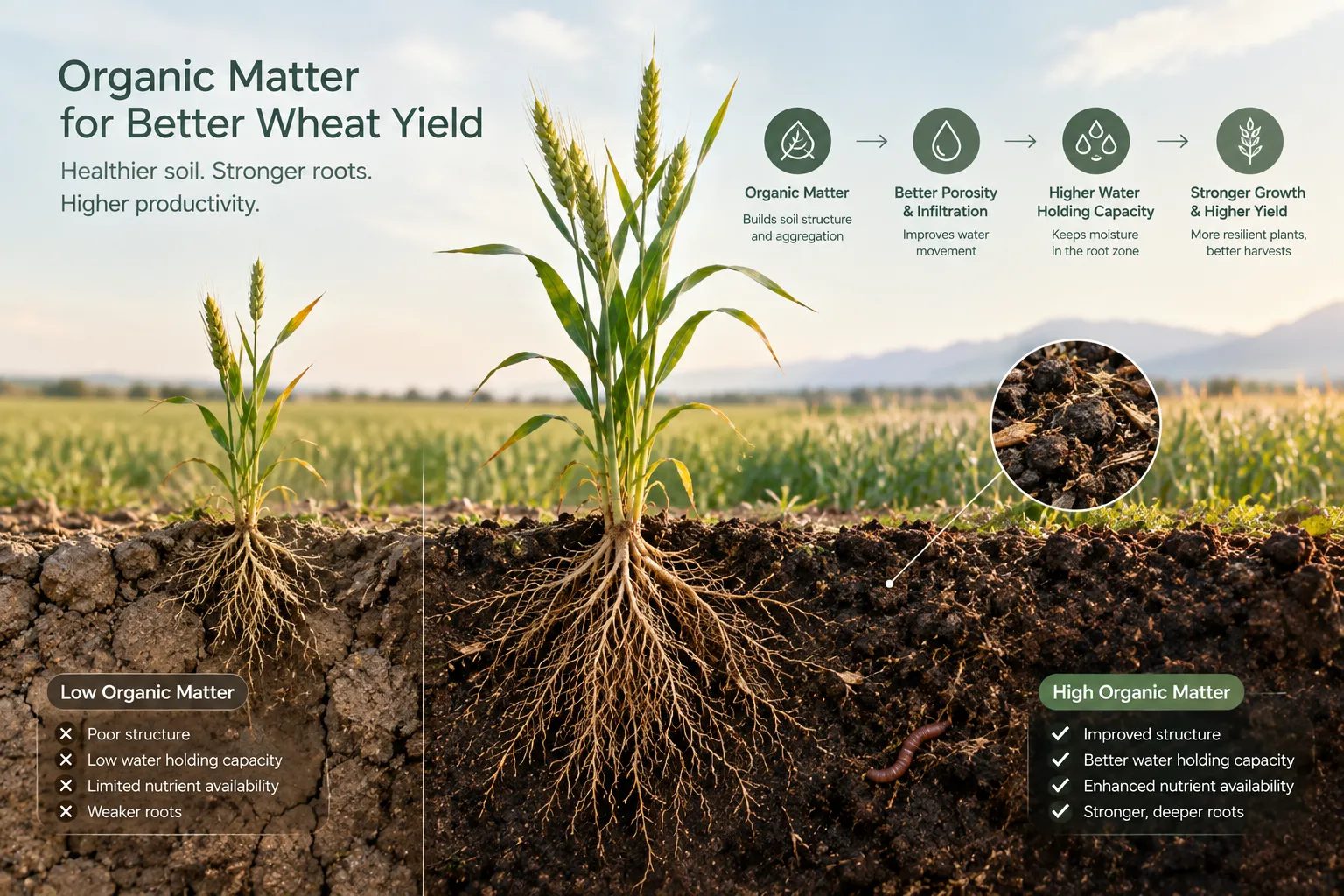
Organic matter contributes to aggregation, nutrient cycling, biological activity and water retention. Suitable inputs may include well-managed manure, mature compost, retained residues, green manures where water and rotations permit, and other properly characterized local amendments.
Their nutrient content, maturity, salinity and possible contaminants should be assessed. This is especially important in salt-affected fields because some manures and composts carry enough soluble salts to increase the salinity burden when used poorly or excessively.
Organic matter can improve soil structure and fertility over time, but it is not a substitute for drainage, irrigation-water assessment or salt management, and it does not rapidly remove accumulated salts. Combine suitable organic inputs with balanced mineral nutrition, residue management and field-specific irrigation.
Why do irrigation and drainage determine fertilizer efficiency?
When irrigation water contains salts, every application adds to the root-zone salt balance. Salts accumulate when inputs exceed removal, so fertilizer efficiency depends on coordinating crop water demand, salt movement and drainage.
Schedule irrigation according to growth stage, soil texture, rooting depth, rainfall and water availability. Leaching can move soluble salts below the root zone only when enough suitable water and adequate drainage are available. Without drainage, extra irrigation may raise the water table and worsen waterlogging and salinity.
Fertilizer timing must follow the same plan. Excess water can move nitrogen and other mobile nutrients below the roots, while fertilizer applied into a dry root zone may remain poorly available. There is no single irrigation amount suitable for every Iraqi wheat field or season.
When should micronutrients be applied?
High pH and salinity can complicate zinc, iron and other micronutrient nutrition, but yellowing, poor tillering and weak growth are not diagnoses by themselves. Similar symptoms can come from salinity, water stress, root injury or disease.
Inspect the field pattern, review soil and water results, use plant-tissue analysis where appropriate, and confirm the likely deficiency before selecting a source, rate and method. Foliar micronutrients can help in specific situations, but they are not a universal remedy for saline soil or restricted roots.
What practical framework can guide field decisions?
| Field condition | Management priority |
|---|---|
| High salinity and low organic matter | Map salt distribution and drainage, assess suitable organic inputs, and establish balanced nutrition. |
| Limited irrigation and low yield potential | Set a realistic yield target and avoid nitrogen beyond likely crop demand. |
| Adequate nitrogen but weak early growth | Investigate salinity, phosphorus availability, establishment and root-zone conditions before adding nitrogen. |
| High pH with suspected micronutrient deficiency | Confirm the deficiency, then select an appropriate source and application method. |
| Saline irrigation water | Assess water quality, salt accumulation, drainage and whether effective leaching is feasible. |
| Poor infiltration or suspected sodicity | Test sodium-related soil conditions before choosing an amendment and drainage intervention. |
Where sodicity is confirmed, gypsum may be suitable for some soils, but the requirement depends on soil chemistry and the management objective. High EC alone is not enough reason to prescribe gypsum.
Which fertilization mistakes should be avoided?
- Increasing fertilizer rates without diagnosing the main constraint.
- Applying excessive nitrogen early when the water supply cannot sustain the resulting canopy.
- Using manure or compost without checking maturity, nutrient content and salinity.
- Ignoring drainage while applying more irrigation water.
- Applying micronutrients based only on leaf color.
- Using one fertilizer formula across fields with different fertility, salinity and yield potential.
- Assuming a salt-tolerant wheat variety no longer needs balanced nutrition.
What is the main takeaway for Iraqi wheat growers?
Build the nutrient program around the field. Match nitrogen to crop demand and water availability, use soil evidence for phosphorus and potassium, diagnose micronutrient problems, improve organic matter over time, and coordinate every application with irrigation-water quality and drainage.
The first step is understanding the soil and water constraints. The next is a balanced program that works within them. Contact Nutrexia to discuss soil, water and wheat nutrition planning for your production conditions.
Research notes and references
The source article uses Iraq-specific research and technical reports while applying general organic-matter principles cautiously. It does not provide universal fertilizer rates.
- ICARDA (2019), Technical and Environmental Efficiency of Wheat Farms in Saline Irrigated Areas of Central Iraq.
- Al-Ghrairi et al., Effect of Some Fertilizer Combinations on Growth and Yield of Wheat Grown in Salt-Affected Soil, Iraq Journal of Agricultural Research, 22(7).
- Modeling the Effects of Different Irrigation Schedules and Drain Depths for Soil Salinity Management: A Case Study from Southern Iraq, African Journal of Agricultural Research (2015).
- FAO / ICARDA, Iraq Salinity Project technical reports on soil, agronomy, irrigation water and drainage management.
- ICARDA (2013), Managing Salinity in Iraq’s Agriculture: Current State, Causes, and Impacts.
Frequently asked questions
Can more fertilizer correct poor wheat growth in saline soil?
Not necessarily. Poor growth may result from salinity, inadequate moisture, waterlogging, sodicity, root damage or nutrient deficiency. Diagnose the main constraint before increasing fertilizer rates.
Should nitrogen be applied in one dose under limited irrigation?
A split program can better match crop demand where later water and field access are reliable, but it is not automatically superior. The schedule should reflect yield potential, soil supply, crop stage and expected water availability.
Does potassium make wheat salt tolerant?
Adequate potassium supports plant function and potassium-sodium balance, but extra potassium does not guarantee salt tolerance. Apply it when soil tests and local recommendations show a need.
Can organic matter remove salts from the root zone?
Organic matter can improve soil function over time, but it does not replace drainage, water-quality assessment or appropriate leaching. Amendments should also be checked for their own soluble-salt content.
About the agronomist

Somayeh Soroush
Plant & Horticultural Expert · Nutrexia R&D Specialist
From productive gardens to advanced greenhouse systems, Somayeh Soroush works where practical horticulture meets modern plant nutrition. She supports progressive growers and greenhouse teams across the Middle East, translating Nutrexia's research into clear, field-ready guidance for diverse crops and growing conditions.
Reviewed by: Somayeh Soroush