Plant Nutrition Fundamentals
Calcium in Plant Nutrition: Mobility, Uptake and Deficiency
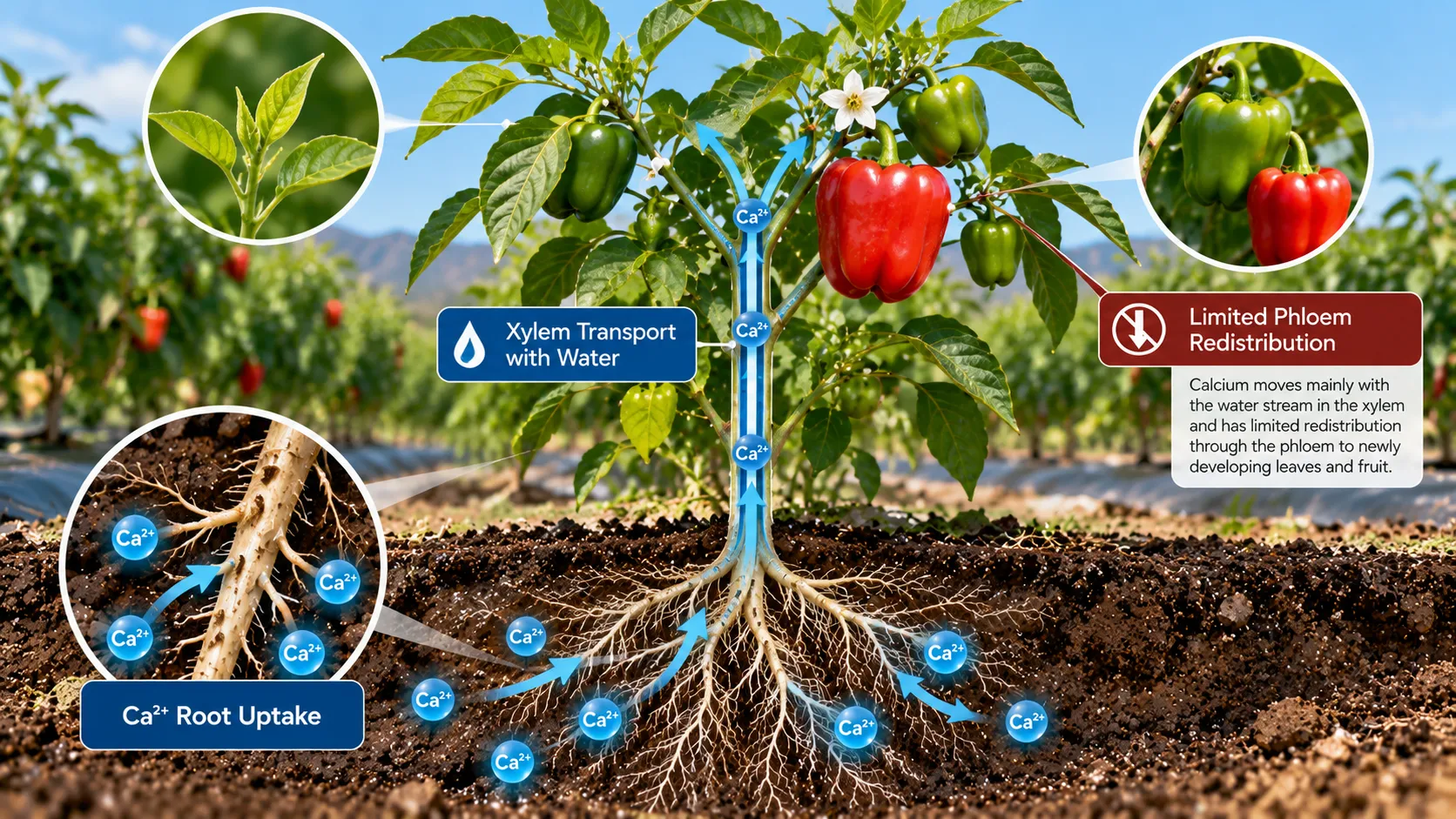
Calcium can be present in the root zone yet fail to reach young leaves, growing points or developing fruit because it moves mainly with water in the xylem and is poorly redistributed through the phloem. Healthy roots, uniform irrigation, transpiration and balanced root-zone conditions are therefore central to calcium delivery.
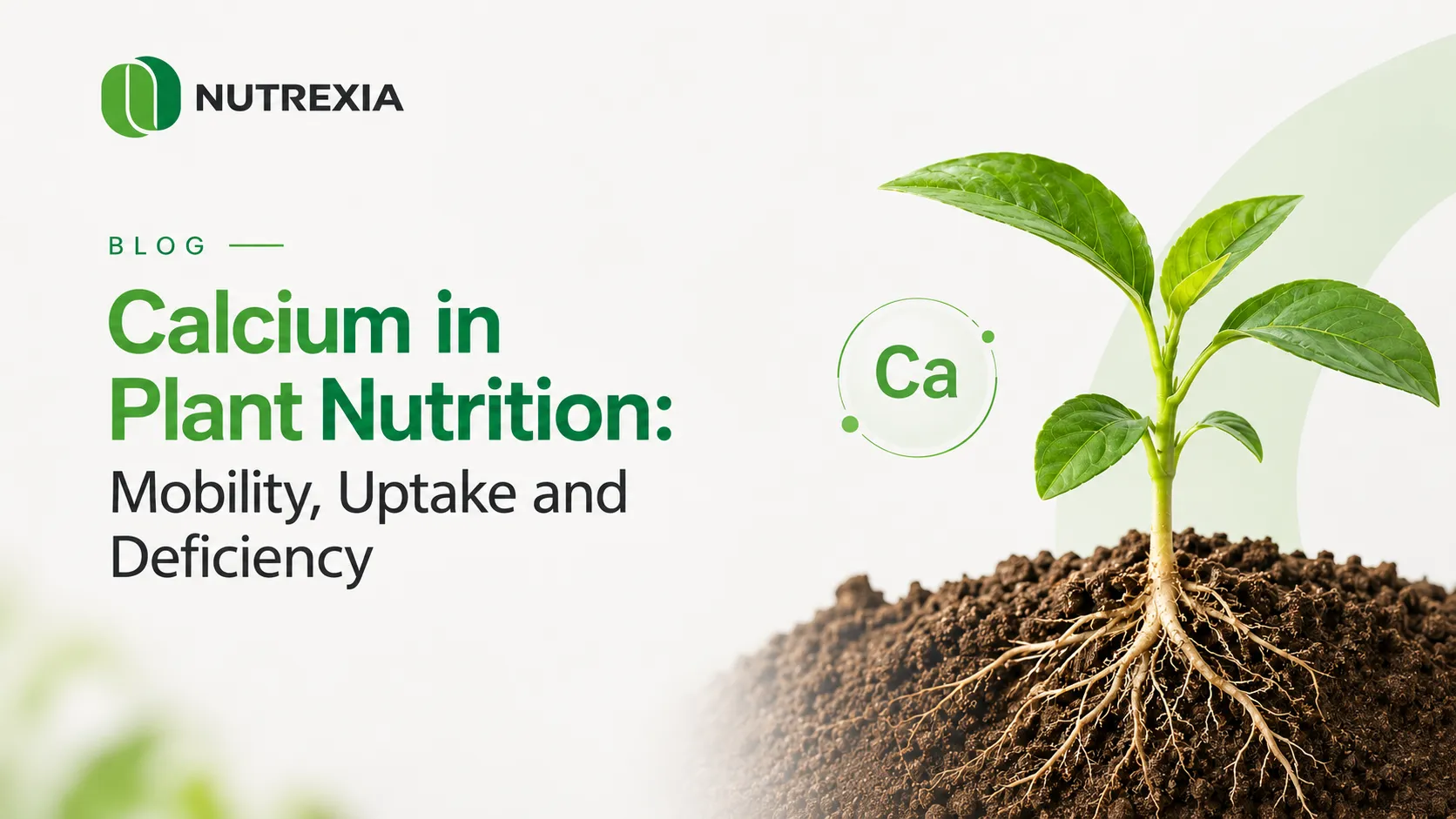
Why can calcium be present in the root zone yet fail to reach the tissues that need it most?
Calcium is essential to plant structure, membrane stability, signaling and crop quality. It is commonly described as the nutrient that strengthens cell walls, but that description misses an important agronomic reality: a crop can have substantial calcium in the soil and still develop calcium-related disorders in young leaves, growing points or developing fruit.
The reason is mobility. Calcium (Ca²⁺) is absorbed by roots and transported predominantly in the xylem with the water stream. Its redistribution through the phloem is limited. Calcium delivery therefore depends strongly on active roots, water movement, transpiration, irrigation uniformity and the crop’s ability to move calcium into rapidly growing tissues.
The practical question is not simply, “Is there enough calcium in the soil?” It is, “Is calcium available, are the roots absorbing it, is water moving through the plant, and is calcium reaching the tissue where demand is highest?”
This guide explains broadly applicable calcium-delivery principles. Exact fertilizer sources, rates, concentrations, timing and compatibility decisions must be based on crop requirements, soil and water analysis, local recommendations and product instructions.
Why is calcium essential for plant growth?
Cell walls and tissue strength
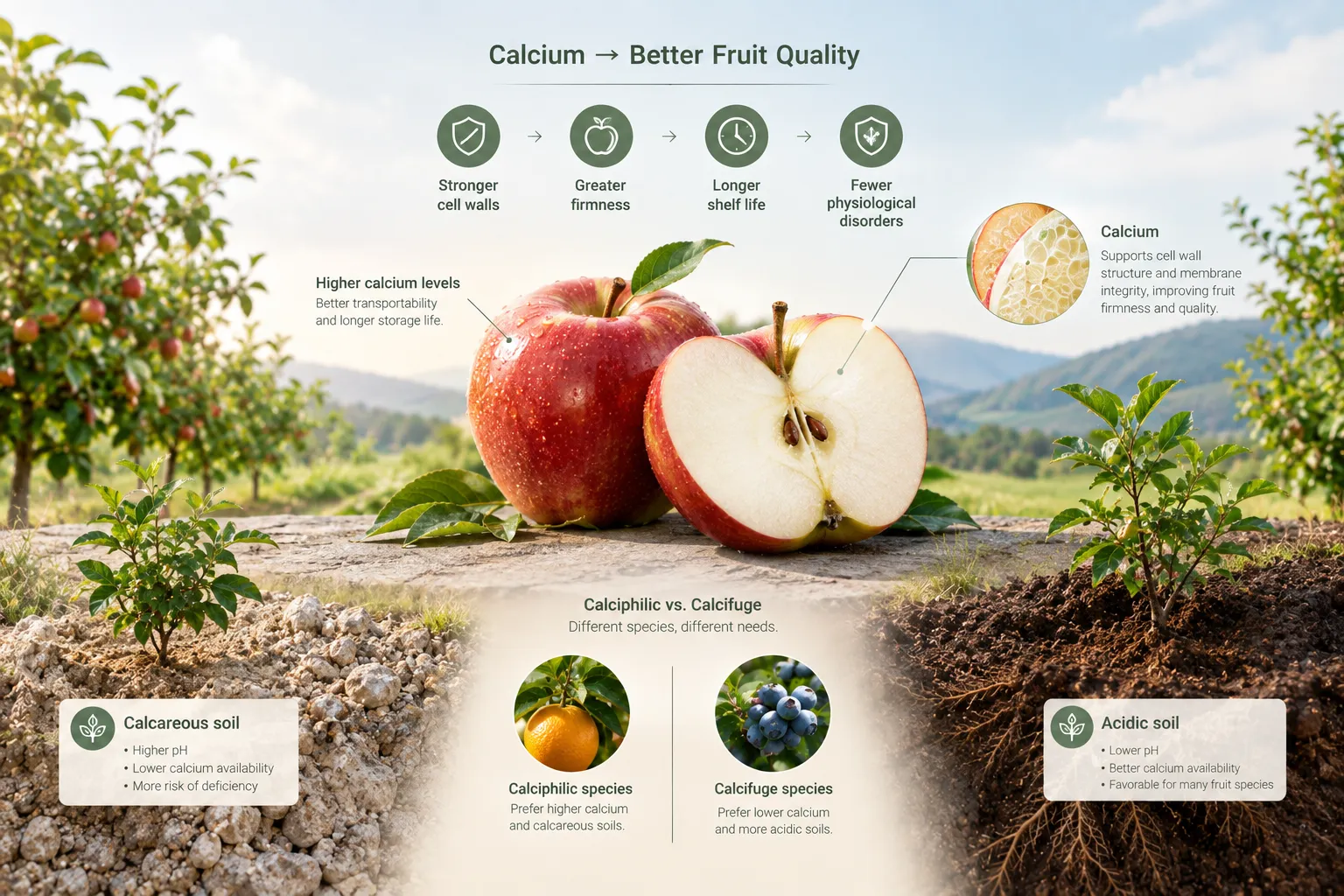
Calcium contributes to the structural organization of plant cell walls, including interactions with pectic components of the middle lamella. This supports cell adhesion and tissue integrity. In horticultural crops, adequate calcium nutrition is associated with firmness and reduced susceptibility to several physiological disorders.
Plasma membrane stability
Calcium contributes to membrane stability and selective permeability. When calcium homeostasis is disturbed, membrane integrity can be compromised, helping explain localized tissue collapse and necrosis.
Calcium as a signaling molecule
Calcium is also a signaling ion. Transient changes in cytosolic Ca²⁺ act as signals involved in development, nutrient responses, stomatal regulation and defense. This dual role—structural nutrient plus signaling ion—means calcium management is part of whole-plant physiology, not simply fertilizer input.
How do plants take up calcium?
Plants absorb calcium primarily as Ca²⁺ from the soil solution. Root uptake and movement toward the xylem are influenced by calcium concentration, root activity, soil chemistry, competing ions, water status and root-zone conditions.
| Stage | What happens | What can limit it |
|---|---|---|
| Root-zone supply | Ca²⁺ must be present in plant-available form. | Low exchangeable Ca, acidity, poor structure or unfavorable chemistry. |
| Root contact | Calcium reaches active roots through soil-water movement. | Dry soil, waterlogging, damaged roots or poor aeration. |
| Root uptake | Ca²⁺ enters root cells through transport systems. | Root stress, salinity or ionic imbalance. |
| Xylem loading | Calcium enters the upward transport stream. | Restricted root function or low water flow. |
| Tissue delivery | Calcium reaches tissues with transpiration flow. | Low transpiration, rapid growth or poor hydraulic continuity. |
Why is calcium mobility the central concept?
Calcium is relatively immobile in the phloem compared with highly mobile nutrients such as nitrogen and potassium. Once accumulated in older tissues, it generally cannot be redistributed efficiently to a newly expanding leaf or developing fruit.
Long-distance delivery therefore depends strongly on xylem flow. Because xylem transport is linked to water movement and transpiration, tissues with lower transpiration can receive less calcium even when other parts of the plant contain adequate calcium.
| Situation | Why delivery can fall | Typical risk |
|---|---|---|
| Low transpiration | Less water moves through the xylem. | Young leaves, inner leaves and developing fruit. |
| Rapid tissue expansion | Demand for structural calcium rises quickly. | Growing points and enlarging fruit. |
| Water stress | Root uptake and hydraulic flow decline. | Localized necrosis and physiological disorders. |
| Waterlogging | Root oxygen and activity decline. | Reduced uptake despite soil calcium. |
| High salinity | Osmotic and ionic stress restrict normal uptake. | Fruit and leaf disorders. |
| Uneven irrigation | Root zones cycle between excess and shortage. | Inconsistent crop response. |
This is why calcium deficiency is often better understood as a delivery problem than as a simple shortage. Tissue-level availability and local hydraulic access can matter more than bulk soil calcium alone.
What can reduce calcium uptake or delivery?
Soil pH and exchange capacity
Interpret calcium together with pH, cation exchange capacity (CEC) and exchangeable cations. Acidic soils can have low base saturation and greater aluminum or manganese constraints, while strongly calcareous soils can create other nutrient-availability limitations. The soil-test interpretation guide explains how these measurements fit into a broader fertilizer plan.
Water and root-zone conditions
Repeated drying and rewetting, prolonged saturation, compaction, poor drainage and damaged roots can interrupt the pathway from fertilizer to tissue.
Salinity and ionic balance
High salinity increases osmotic stress and can reduce normal root water uptake. Calcium programs should therefore be evaluated with EC, irrigation-water composition and the overall potassium-calcium-magnesium balance.
Crop vigor and growth rate
Fast-growing crops can create periods when calcium demand in expanding tissues is high. If transpiration or root activity is restricted at the same time, localized disorders can appear quickly.
How can calcium deficiency be recognized in the field?
Because calcium is poorly redistributed from mature tissues, symptoms often develop first in young, actively growing tissues. Responses can include distorted young leaves, weak growing points, marginal or tip necrosis, tissue collapse and poor development of rapidly expanding organs.
In fruit crops, calcium-related disorders may be localized rather than expressed as uniform whole-plant deficiency. Visual diagnosis should therefore be combined with soil, water, root-zone and tissue information.
| Observation | Possible interpretation | Check next |
|---|---|---|
| Young tissue affected first | Limited calcium redistribution. | Root supply, irrigation, transpiration and tissue analysis. |
| Tip or margin necrosis | Localized calcium delivery failure or another stress. | EC, water status, roots and competing symptoms. |
| Fruit disorder without general leaf deficiency | Tissue-specific limitation. | Crop load, water consistency, roots and fruit calcium. |
| Symptoms after heat or salinity | Hydraulic or physiological stress. | Irrigation EC, water availability and root-zone conditions. |
| Older leaves adequate, new tissue affected | Calcium accumulated where transpiration was higher. | Confirm the mobility pattern and rule out other deficiencies. |
Why is blossom-end rot more than “not enough calcium”?
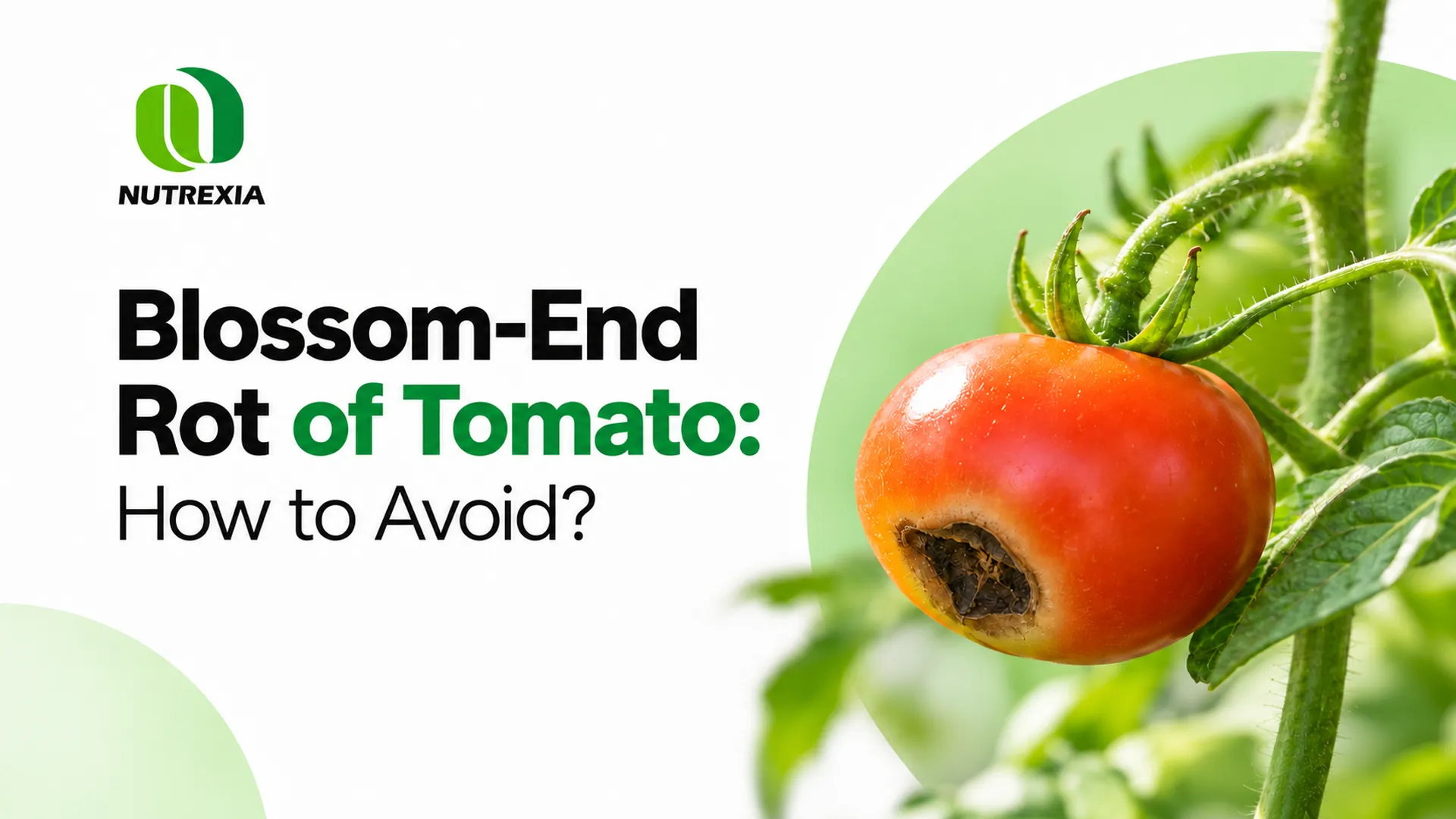
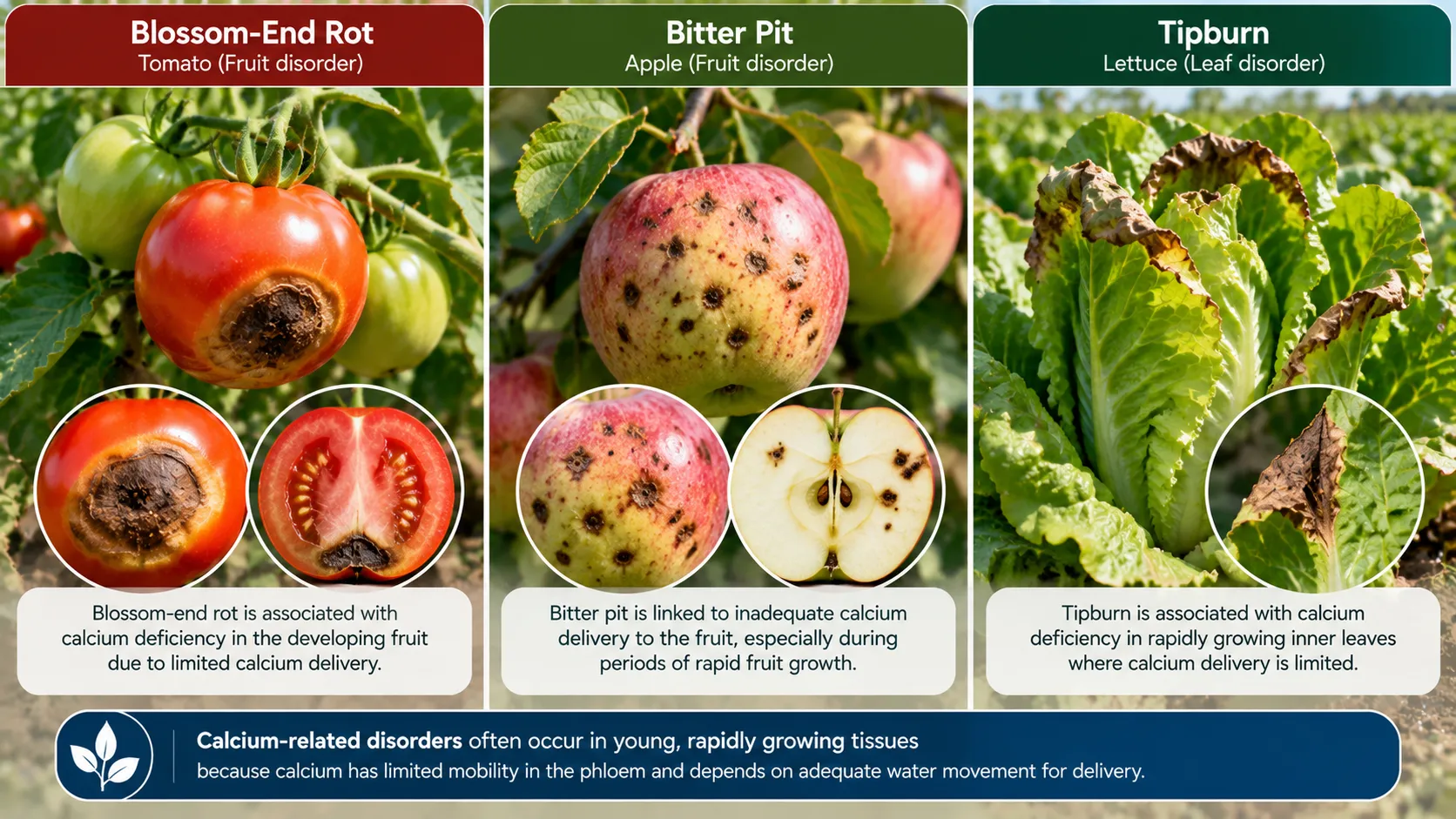
Blossom-end rot in tomato and pepper is a classic example of why calcium nutrition must be understood physiologically. The disorder is strongly associated with inadequate calcium supply to susceptible fruit tissue, but it is not reliably corrected simply by adding more calcium fertilizer.
Water stress, salinity, high evaporative demand, rapid fruit growth, root restriction and fluctuations in water supply can alter calcium delivery and tissue susceptibility. The relationship between calcium status and blossom-end rot is complex; tissue-level calcium loss can accompany a broader stress process rather than proving that the entire crop lacks calcium.
| Instead of asking… | Ask… |
|---|---|
| How much calcium should I add? | Is calcium available and reaching the fruit? |
| Why is there blossom-end rot if the soil has calcium? | Are roots, water flow and fruit demand aligned? |
| Should I spray calcium? | Will the treatment reach the susceptible tissue at the required time? |
| Is calcium the only problem? | What are EC, irrigation, roots, crop vigor and environment doing? |
How are bitter pit, tipburn and other disorders related to calcium?
Bitter pit in apple
Bitter pit is associated with calcium distribution in apple fruit, but its development is multifactorial. Cultivar and rootstock, crop load, water relations, vegetative vigor, mineral balance and environmental stress can all influence risk. Fruit calcium should therefore be interpreted as part of an integrated diagnosis.
Tipburn
Tipburn in crops such as lettuce is another classic example of localized calcium-delivery failure. Young inner leaves can have relatively low transpiration, so calcium supply may not keep pace with rapid tissue expansion. Greenhouse climate, air movement, humidity, irrigation and root-zone conditions can be as important as fertilizer concentration.
Citrus and perennial crops
In citrus, reported patterns can include marginal or interveinal chlorosis, small necrotic spots, reduced vigor and smaller leaves. Diagnosis in perennial systems should also consider soil pH, drainage, nutrient balance, seasonal growth and long-term soil chemistry.
How should calcium be managed in the root zone?
Start with soil and water testing
Review soil pH, CEC, exchangeable calcium and the calcium-magnesium-potassium-sodium balance where available. For irrigation water, review EC and major ions, especially where salinity or bicarbonate may influence the system.
Protect root activity
Maintain appropriate moisture, drainage and aeration; avoid prolonged saturation; correct compaction where possible; and manage salinity before it becomes a chronic root-zone problem.
Keep irrigation uniform
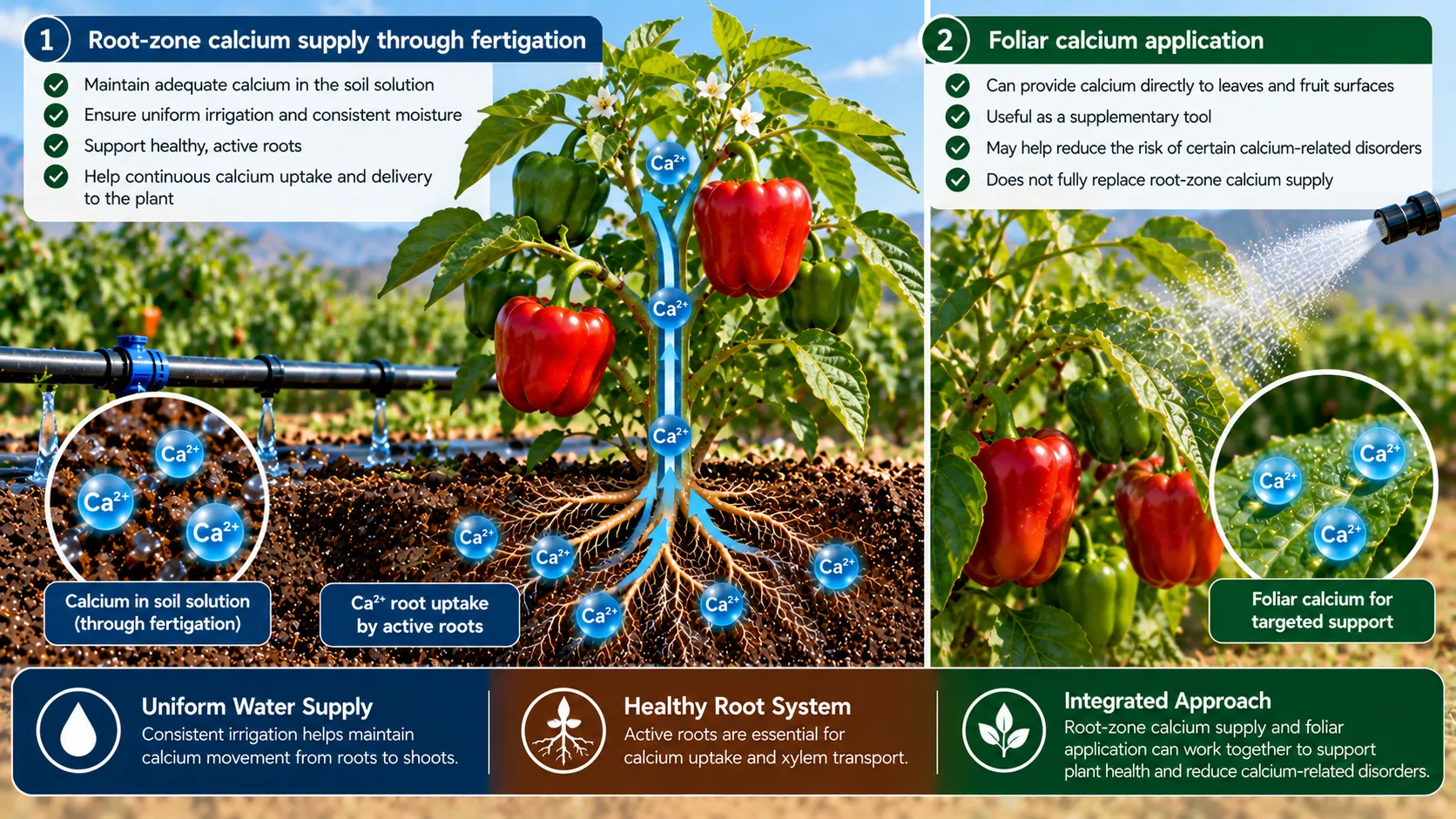
For fertigation, uniform distribution matters as much as fertilizer concentration. Check emitter performance, pressure, duration, frequency and drainage. Repeated root-zone drying can create large fluctuations in plant water status and calcium delivery.
Match supply to crop demand
Calcium management should become more deliberate during rapid canopy or fruit expansion. The objective is not a large calcium pulse, but a consistent supply that supports continuous root uptake and xylem delivery.
How can fertigation deliver calcium consistently?
Fertigation can maintain a continuous calcium supply directly in the active root zone, but its success depends on system design and chemistry.
| Checkpoint | Practical question |
|---|---|
| Water analysis | What are EC, calcium, magnesium, sodium, bicarbonate and other relevant ions? |
| Injector calibration | Does actual injection match the intended rate? |
| Distribution uniformity | Are plants receiving similar irrigation and nutrient volumes? |
| Compatibility | Can the calcium source be safely combined in the stock solution? |
| Root-zone EC | Is salinity restricting water uptake? |
| Timing | Is calcium supplied consistently during high-demand periods? |
| Monitoring | Do moisture, drainage and crop response support the program? |
Calcium fertilizers also require attention to compatibility. In concentrated stock solutions, calcium can react with sulfate or phosphate sources and form poorly soluble compounds. Depending on formulation and water chemistry, separate stock tanks or appropriate injection sequences may be necessary.
Where can foliar calcium help—and where does it not?
Foliar calcium can be useful in specific crop and quality programs, particularly when the target is an exposed surface or developing organ. However, limited phloem mobility means foliar application should not automatically be treated as a whole-plant correction for root-zone or xylem-delivery problems.
Define the target first: Which tissue needs calcium? At what stage? Can the spray reach that tissue? Will it complement root-zone management rather than substitute for it?
How should calcium management change through the crop cycle?
| Growth stage | Calcium priority | Management focus |
|---|---|---|
| Establishment | Build active roots and stable uptake. | Moisture, aeration, salinity and balanced nutrition. |
| Vegetative growth | Support expanding young tissues. | Continuous supply, irrigation uniformity and stress avoidance. |
| Flowering and fruit set | Protect developing sinks. | Stable water supply; avoid abrupt EC or irrigation changes. |
| Fruit enlargement | Maintain delivery to expanding tissue. | Root activity, water movement, crop load and consistent fertigation. |
| Pre-harvest | Support firmness and quality where relevant. | Avoid late stress and maintain balanced nutrition. |
The potassium-management guide provides complementary guidance on uptake, water relations, crop stages and nutrient balance.
What should a practical calcium diagnosis include?
- Map the symptom: young leaf, growing point, fruit, inner canopy or older tissue.
- Check irrigation frequency, duration and distribution uniformity.
- Measure root-zone EC and moisture where possible.
- Inspect roots for poor aeration, disease, restriction or reduced active root volume.
- Review soil pH, CEC and exchangeable calcium, magnesium, potassium and sodium where available.
- Analyze irrigation water, especially EC and major cations or bicarbonate.
- Review crop vigor, crop load and recent environmental stress.
- Use tissue analysis to compare affected and healthy tissue when appropriate.
- Ask whether the problem is supply, root uptake, xylem transport or tissue demand.
- Only then choose soil application, fertigation, foliar treatment or primarily irrigation and root-zone correction.
What are the most common calcium-management mistakes?
| Mistake | Better approach |
|---|---|
| Assuming every disorder means low soil calcium. | Calcium delivery and tissue demand can be limiting even when bulk soil calcium is adequate. |
| Treating blossom-end rot with fertilizer alone. | Evaluate water status, salinity, root health and fruit growth. |
| Ignoring irrigation uniformity. | Uneven water delivery creates uneven root activity and calcium supply. |
| Using foliar calcium as a universal fix. | Limited phloem mobility restricts redistribution to internal tissues. |
| Ignoring nutrient balance. | Interpret calcium with magnesium, potassium, sodium and the full fertilizer program. |
| Diagnosing visually without data. | Symptoms overlap with other nutrient, salinity and environmental disorders. |
What is the Nutrexia calcium-management framework?
For practical crop nutrition, calcium can be viewed as a complete delivery chain:
Root-zone calcium → root uptake → xylem and water flow → target tissue → cell-wall and membrane function
A weakness anywhere in this chain can reduce the benefit of calcium fertilization. Calcium programs should therefore be evaluated as part of the whole crop-nutrition and irrigation system, not as an isolated nutrient dose.
Manage calcium as a delivery system
Calcium is fundamental to plant structure, membrane integrity, signaling and crop quality. Its low phloem mobility, however, makes its nutrition different from that of highly mobile nutrients. A plant cannot simply move large amounts of calcium from an older leaf to a rapidly expanding fruit or young leaf when local supply is inadequate.
The most effective calcium strategy is built around four questions: Is calcium available in the root zone? Are roots healthy enough to absorb it? Is water moving efficiently through the plant? Is calcium reaching the tissue where demand is highest?
When these questions are answered together, calcium management becomes more precise. Instead of responding to symptoms with more fertilizer, growers can identify the actual bottleneck—soil chemistry, roots, irrigation, salinity, transpiration, crop demand or tissue-level delivery—and correct the system.
Contact Nutrexia to discuss a crop-nutrition strategy based on crop demand, soil and water conditions, production system and field objectives.
Scientific references
- Thor, K. (2019). Calcium—Nutrient and Messenger. Frontiers in Plant Science, 10, 440.
- White, P. J., & Broadley, M. R. (2003). Calcium in plants. Annals of Botany, 92(4), 487–511.
- Zörb, C., & Geilfus, C.-M. (2026). Calcium in agriculture and crop production. Trends in Plant Science.
- Role of calcium nutrition in plant physiology: Advances in research and insights into acidic soil conditions—A comprehensive review (2024). Plant Physiology and Biochemistry, 210, 108602.
- Calcium signaling in plant mineral nutrition: From uptake to transport (2023). Plant Communications, 4(6), 100678.
- Why calcium deficiency is not the cause of blossom-end rot in tomato and pepper fruit—a reappraisal (2014). Scientia Horticulturae, 174, 151–154.
Frequently asked questions
Why can calcium deficiency occur when soil calcium is adequate?
Calcium must be available in the soil solution, absorbed by active roots and carried with water through the xylem to the target tissue. Dryness, waterlogging, salinity, poor roots, uneven irrigation, low transpiration or rapid tissue expansion can interrupt this delivery chain even when bulk soil calcium is adequate.
How does calcium move through a plant?
Calcium moves predominantly upward in the xylem with the water stream. Its redistribution through the phloem is limited, so calcium already accumulated in older tissues cannot be moved efficiently to newly expanding leaves or developing fruit.
Is blossom-end rot always caused by low soil calcium?
No. Blossom-end rot is associated with inadequate calcium delivery to susceptible fruit tissue, but irrigation fluctuations, salinity, root restriction, rapid fruit growth and environmental stress can contribute even when the root zone contains calcium.
Can foliar calcium replace root-zone calcium supply?
Usually not. Foliar calcium may support exposed leaves or fruit surfaces in specific crop programs, but limited phloem mobility restricts redistribution to internal or newly developing tissues. It should complement, not automatically replace, root-zone management.
What should growers check before applying more calcium?
Check symptom location, irrigation frequency and uniformity, root-zone moisture and EC, root health, soil pH and exchangeable cations, irrigation-water chemistry, crop vigor, crop load and recent environmental stress. This helps identify whether the bottleneck is supply, uptake, transport or tissue demand.
About the agronomist

Somayeh Soroush
Plant & Horticultural Expert · Nutrexia R&D Specialist
From productive gardens to advanced greenhouse systems, Somayeh Soroush works where practical horticulture meets modern plant nutrition. She supports progressive growers and greenhouse teams across the Middle East, translating Nutrexia's research into clear, field-ready guidance for diverse crops and growing conditions.
Reviewed by: Somayeh Soroush