Plant Nutrition Fundamentals
Potassium Management: Uptake, Timing and Losses
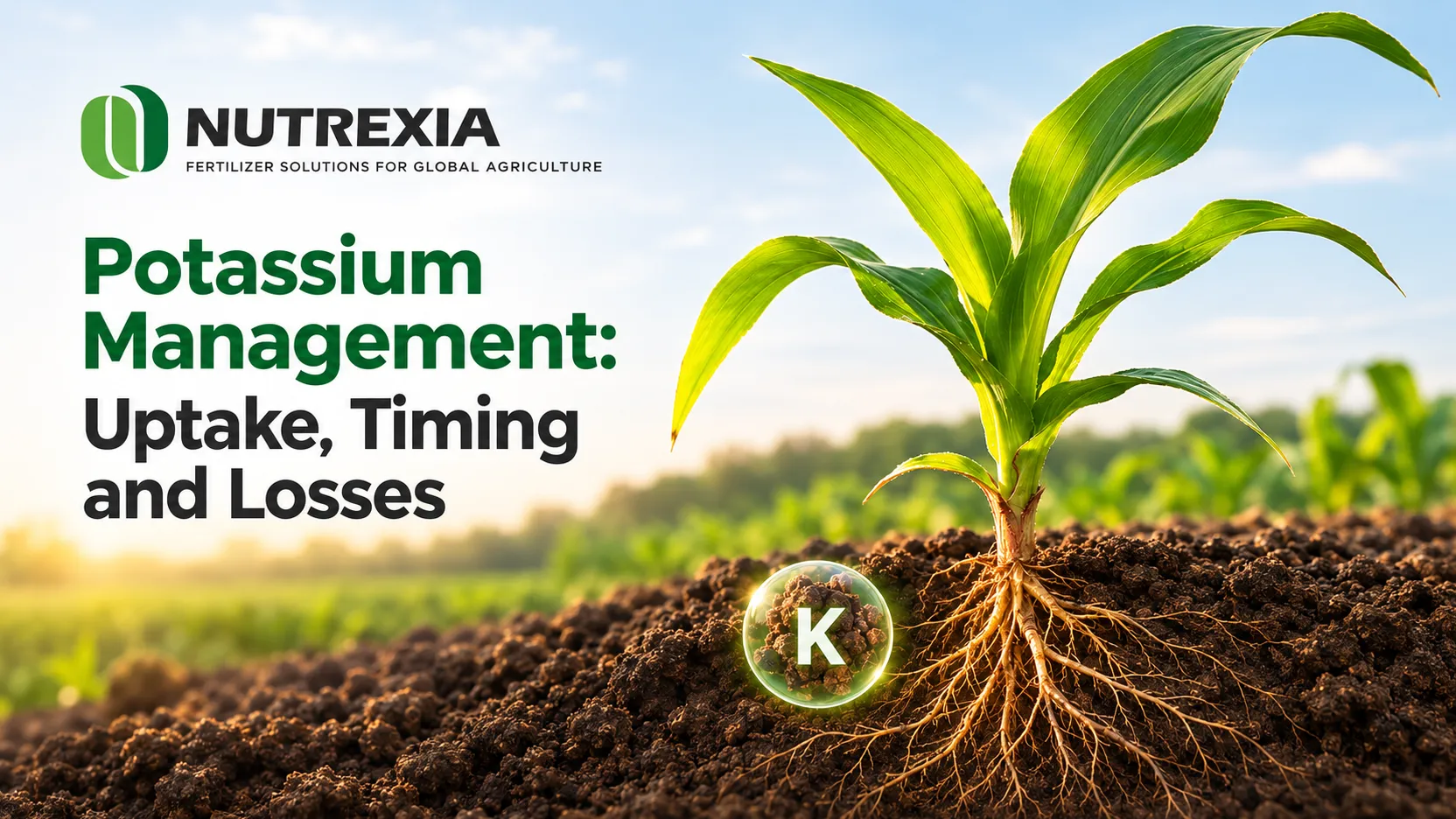
Effective potassium management keeps potassium accessible to active roots when crop demand is high. Soil supply, root activity, moisture, growth stage, placement, and water movement all influence uptake and potential losses.
How should potassium be managed for effective crop uptake?
Effective potassium management means keeping potassium available to active roots when crop demand is high. Applying fertilizer alone does not guarantee uptake: soil potassium supply, root activity, moisture, crop stage, placement, and water movement all influence how much potassium the plant can access.
Potassium supports water regulation, enzyme activity, photosynthesis, stomatal movement, cell expansion, and the transport of sugars and other compounds. A sound program therefore starts with soil and crop information, aligns supply with changing demand, maintains suitable root-zone conditions, and monitors crop response. Exact rates, sources, and schedules must be adapted to the crop, soil, irrigation system, local conditions, and product instructions.
Why potassium management matters
Potassium is one of the three primary macronutrients, but its role inside the plant is mainly regulatory rather than structural. It helps plants manage water, activate enzymes, regulate stomata, support photosynthesis, transport sugars, and maintain cellular balance.
For growers, potassium management is not only about applying enough fertilizer. It is also about keeping potassium accessible when the crop needs it and reducing the conditions that restrict availability in the root zone.
How do plants take up potassium?
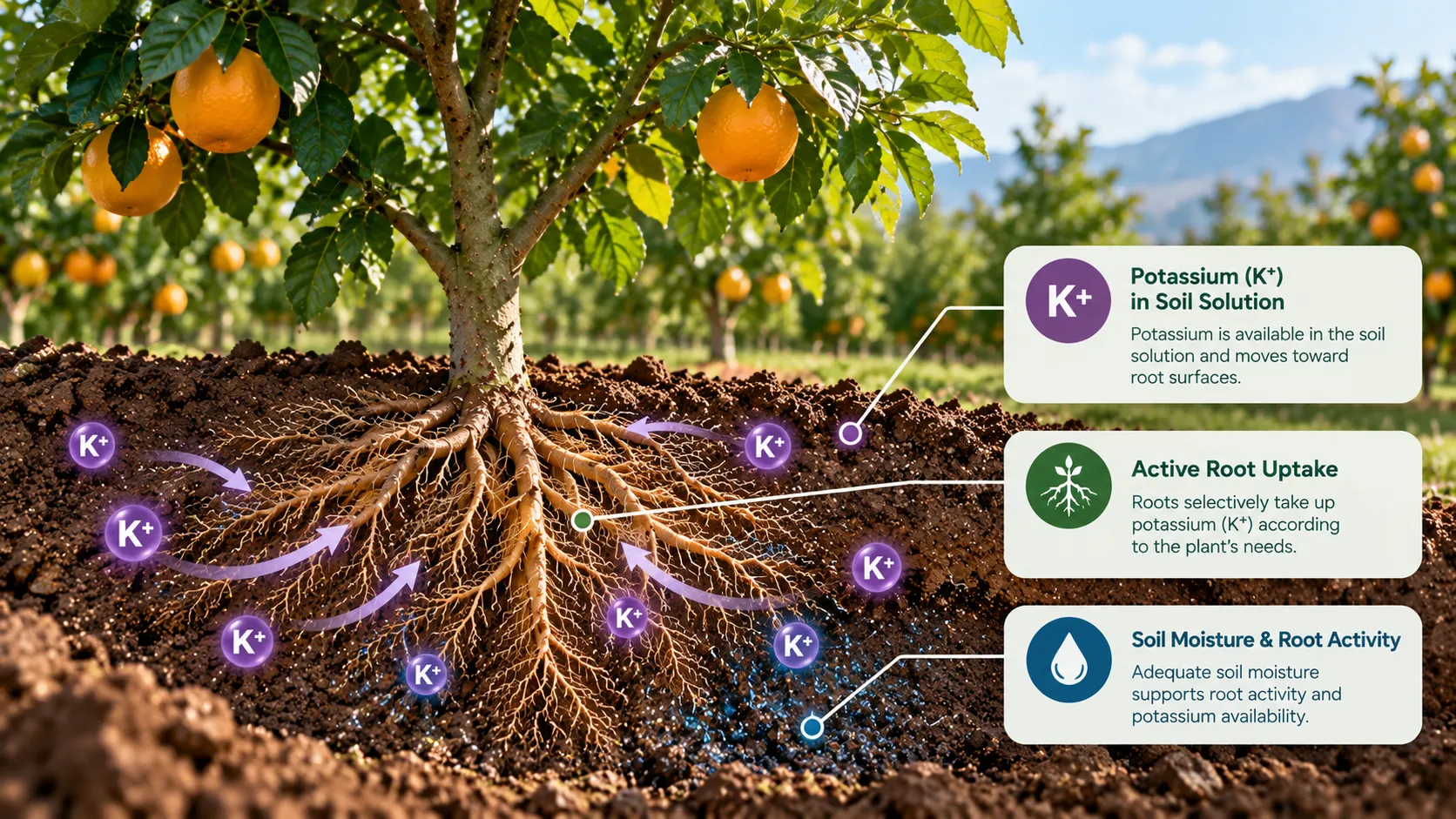
Potassium uptake is selective and energy-dependent. Roots regulate the entry of potassium ions according to the plant’s needs. Once inside the plant, potassium is highly mobile and can move through cells and through the xylem and phloem. This mobility allows it to be redistributed as demand changes among tissues and growth stages.
A potassium application does not automatically mean that the crop can access the nutrient. Root activity, soil conditions, moisture, and physiological demand all affect how effectively potassium reaches the plant.
What does potassium do inside the plant?
Enzyme activation
Many plant enzymes depend on potassium or function more effectively when potassium is present. Potassium helps these proteins maintain the structure needed for biochemical reactions.
When potassium is deficient, carbohydrate metabolism and other processes can be disrupted. Soluble carbohydrates and nitrogen compounds may accumulate while starch levels fall.
Protein synthesis
Potassium is involved in protein synthesis, including processes associated with RNA and ribosomes. When potassium is insufficient, amino acids, amides, and nitrates can accumulate because normal protein-building processes are affected.
Photosynthesis
Potassium helps create the conditions needed for ATP formation and carbon dioxide fixation and also influences stomatal function. A deficiency can therefore reduce photosynthetic activity.
This relationship is particularly relevant under drought and salinity, which can restrict potassium uptake and photosynthesis. Adequate potassium supports the plant’s physiological response, but it does not replace irrigation management or eliminate environmental stress.
How does potassium support water relations and cell expansion?
Potassium contributes to osmotic balance and helps maintain the pressure needed for cell expansion and the movement of water and solutes. During cell expansion, potassium accumulation contributes to osmotic potential inside cells.
When potassium is deficient, cells may have lower turgor, smaller cell size, and reduced leaf expansion. Good potassium management therefore supports active growth and the plant’s ability to regulate water, but it cannot compensate for inadequate irrigation or unsuitable root-zone conditions.
How does potassium control stomatal movement?
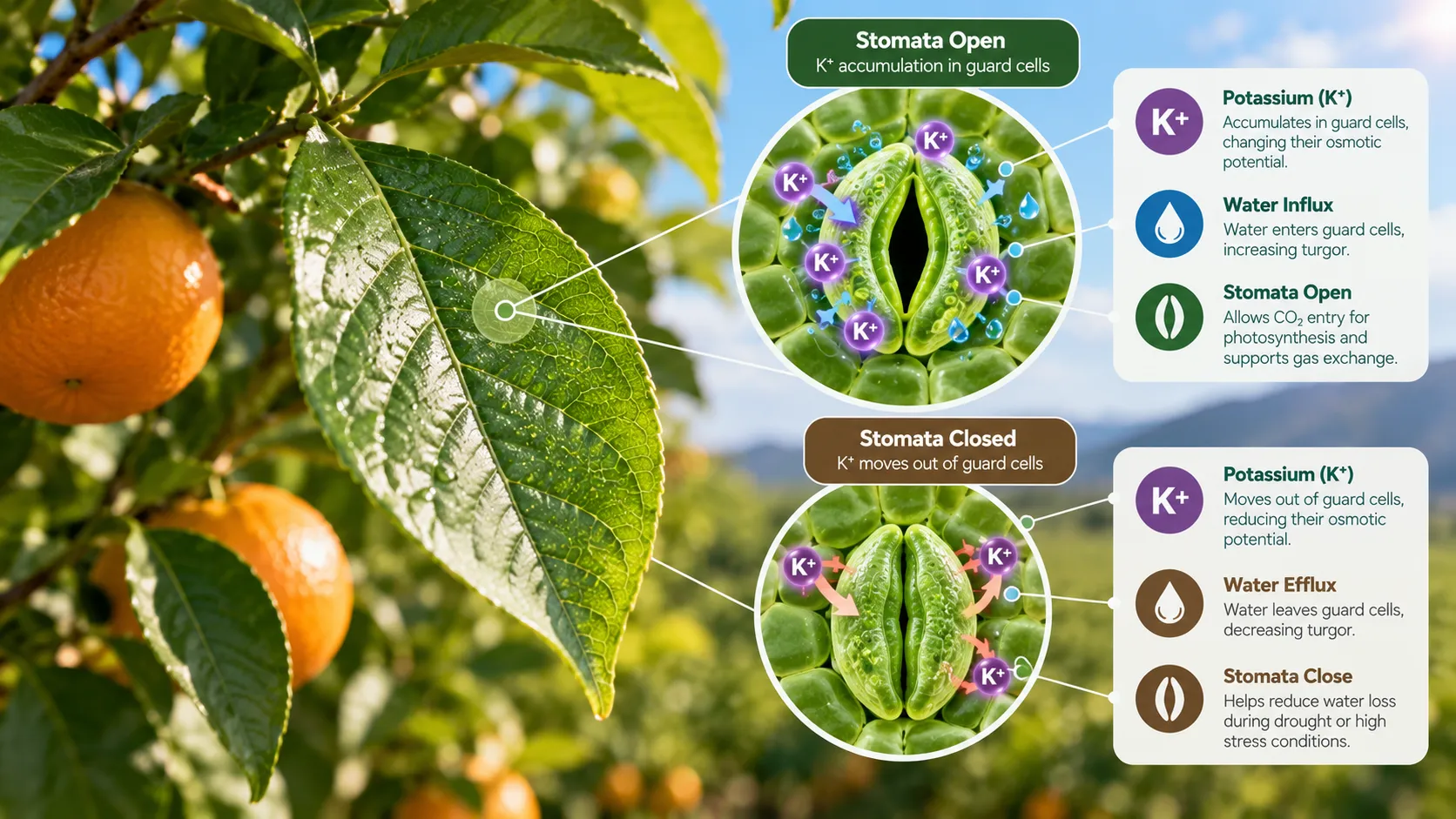
Stomata are small openings on the leaf surface that regulate gas exchange and water loss. Potassium plays a central role in changing the turgor of the guard cells surrounding each opening.
When potassium accumulates in guard cells, their osmotic potential changes and water enters. The resulting increase in turgor helps open the stomata, allowing carbon dioxide to enter for photosynthesis. When potassium moves out, water follows, turgor decreases, and the stomata can close. Potassium status can therefore influence the balance between photosynthesis and water management.
How does potassium support the transport of sugars and nutrients?
Potassium contributes to the movement of substances through the phloem and to sucrose loading. It helps support the transport of photosynthates from source tissues, such as mature leaves, toward tissues that use or store them.
Potassium also contributes to cation-anion balance. It can act as a counter-ion for nitrate during long-distance transport in the xylem and during storage in plant tissues.
When should potassium be applied?
There is no universal potassium schedule for every crop and production system. Timing should be based on crop demand, root activity, soil potassium supply, soil moisture, and the way the crop is grown.
As a practical principle, potassium availability should be aligned with periods of active growth and strong demand for water regulation, photosynthesis, and transport. The exact timing, source, rate, and application method should be adjusted to the crop, soil or substrate, irrigation system, local conditions, and product label.
A practical timing approach
- Assess soil potassium supply before building the fertilizer program.
- Consider the crop’s growth stages and expected periods of high demand.
- Maintain potassium availability instead of relying only on a late corrective application.
- Consider soil moisture and root activity when planning applications.
- Where agronomically appropriate, divide applications to improve synchronization between supply and crop uptake.
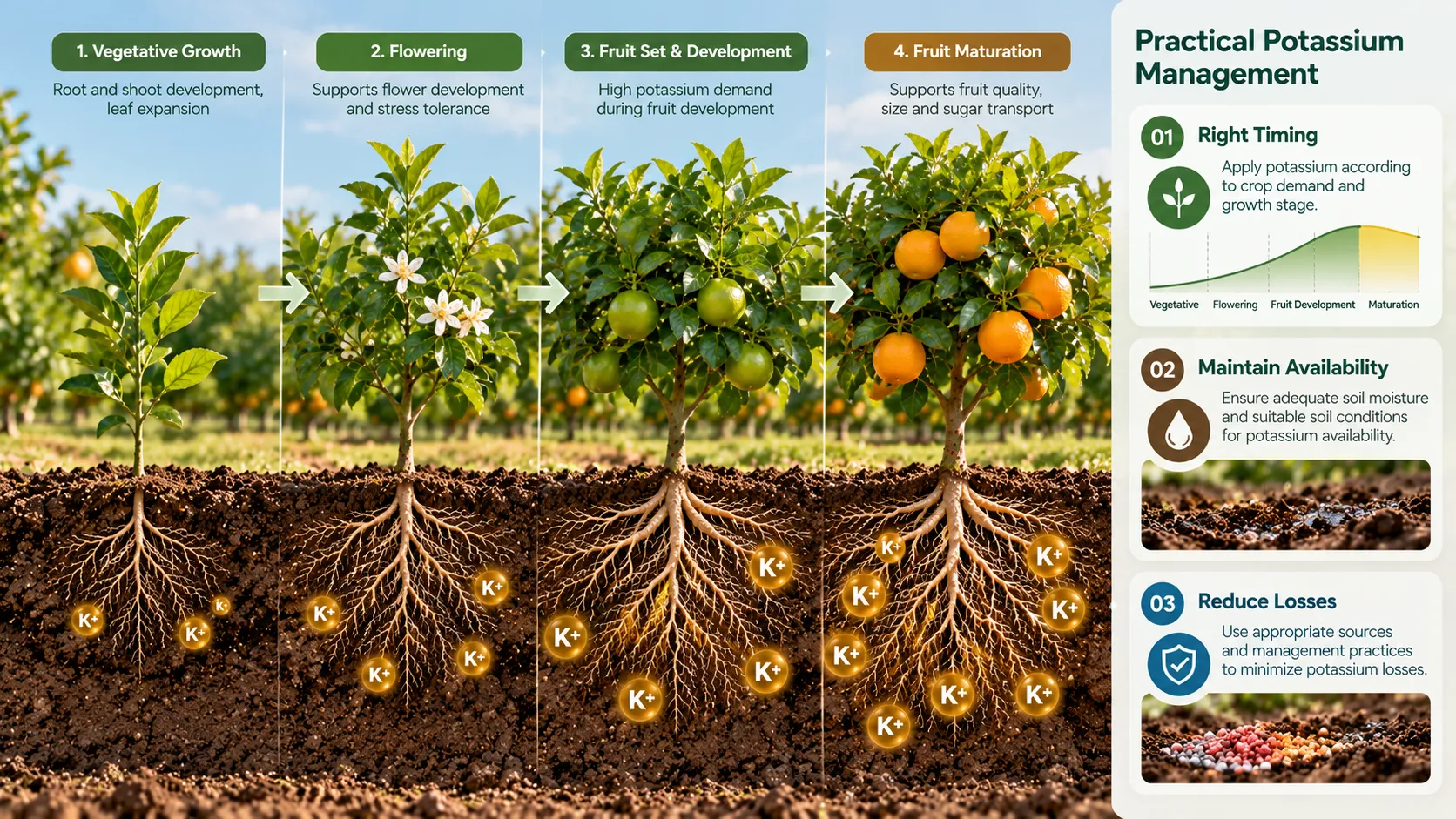
The growth-stage illustration presents a general management concept, not a crop-specific fertilizer schedule. Demand patterns and application decisions must be verified for the crop and local production system.
What can reduce potassium availability or increase losses?
Potassium availability after application is influenced by soil characteristics, water movement, crop uptake, and fertilizer source and placement. The relative importance of these factors varies among soils and production systems, so universal loss percentages should not be assumed.
Management should focus on keeping potassium in the active root zone and synchronizing supply with crop demand. Ask:
- Is potassium being supplied where active roots can access it?
- Is application timing aligned with crop demand?
- Could soil type or heavy water movement reduce potassium availability in the root zone?
- Is the fertilizer program being adjusted according to soil tests and crop performance?
How can potassium-use efficiency be improved?
Efficient potassium management is not simply a matter of increasing the fertilizer rate. The objective is to provide an adequate and accessible supply while matching application timing to crop demand.
- Start with soil and crop information rather than a fixed rate.
- Match potassium supply to crop development and expected demand.
- Maintain suitable root-zone moisture and support active roots.
- Use split applications when they provide a better match between supply and uptake.
- Monitor crop performance and adjust the program when availability or demand changes.
Potassium-management field checklist
- Know the soil potassium status.
- Understand the crop’s potassium demand.
- Keep potassium available in the active root zone.
- Consider water management and soil characteristics.
- Align applications with crop growth and demand.
- Monitor crop response instead of relying on fertilizer rate alone.
- Review the program season by season and crop by crop.
Manage potassium, not just potassium fertilizer
Potassium is more than a nutrient added to soil. Inside the plant, it helps regulate water relations, activate enzymes, support photosynthesis, control stomatal movement, promote cell expansion, and transport sugars and other compounds.
The most effective strategy starts with the crop, the soil, and changing plant demand. When supply is planned around these factors, growers can move from simply applying fertilizer to managing plant nutrition with greater precision.
Every crop has its own potassium demand, soil conditions, and production goals. Contact Nutrexia to discuss a nutrition program suited to your crop, soil, irrigation, and field conditions.
Frequently asked questions
How do plants take up potassium?
Roots selectively take up potassium ions from the soil solution according to plant demand. Effective uptake depends on potassium availability near active roots, suitable soil moisture, root activity, and favorable root-zone conditions.
When should potassium fertilizer be applied?
There is no universal schedule. Timing should follow the crop's growth stages and potassium demand while accounting for soil potassium supply, root activity, moisture, and the production system. Split applications may improve synchronization where they are agronomically appropriate.
Does applying potassium fertilizer guarantee crop uptake?
No. Potassium must remain available in the active root zone, and roots must be able to access it. Soil conditions, moisture, placement, root activity, and crop demand all affect uptake.
How can potassium losses or reduced availability be limited?
Use soil and crop information to select the source, placement, and timing; keep potassium accessible to active roots; account for soil type and water movement; and monitor crop performance so the program can be adjusted.
About the agronomist

Somayeh Soroush
Plant & Horticultural Expert · Nutrexia R&D Specialist
From productive gardens to advanced greenhouse systems, Somayeh Soroush works where practical horticulture meets modern plant nutrition. She supports progressive growers and greenhouse teams across the Middle East, translating Nutrexia's research into clear, field-ready guidance for diverse crops and growing conditions.
Reviewed by: Somayeh Soroush