Plant Nutrition Fundamentals
Macronutrients vs Micronutrients in Plant Nutrition
Macronutrients are required in larger amounts, while micronutrients are needed in much smaller quantities. Both are essential, and effective management depends on crop demand, nutrient availability, growth stage and diagnosis.
What is the difference between macronutrients and micronutrients?
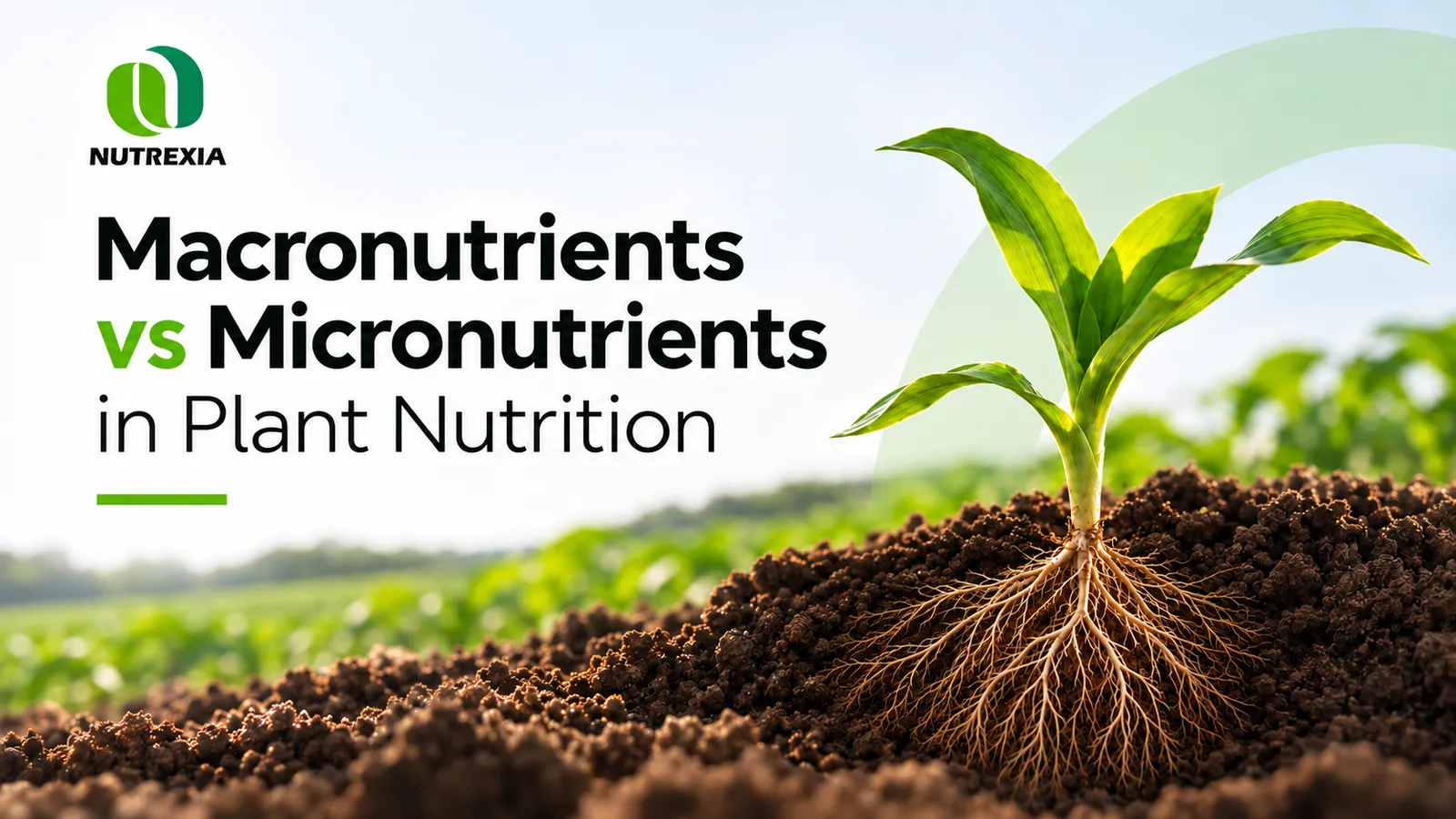
Macronutrients are nutrients a crop needs in comparatively large amounts. Micronutrients are needed in far smaller quantities. The difference describes quantity, not importance. A small shortage of zinc or boron can restrict a crop just as surely as a large shortage of nitrogen.
Macronutrients usually form the bulk of a fertilizer program and are often managed in kilograms per hectare or pounds per acre. Micronutrients are applied at much lower rates and require greater precision. For both groups, the right decision begins with the crop, soil, water and growth stage rather than a universal formula.
This guide is globally applicable, but crop-specific sufficiency ranges, rates, product labels and regulatory requirements must come from qualified local guidance.
Which nutrients are macronutrients?
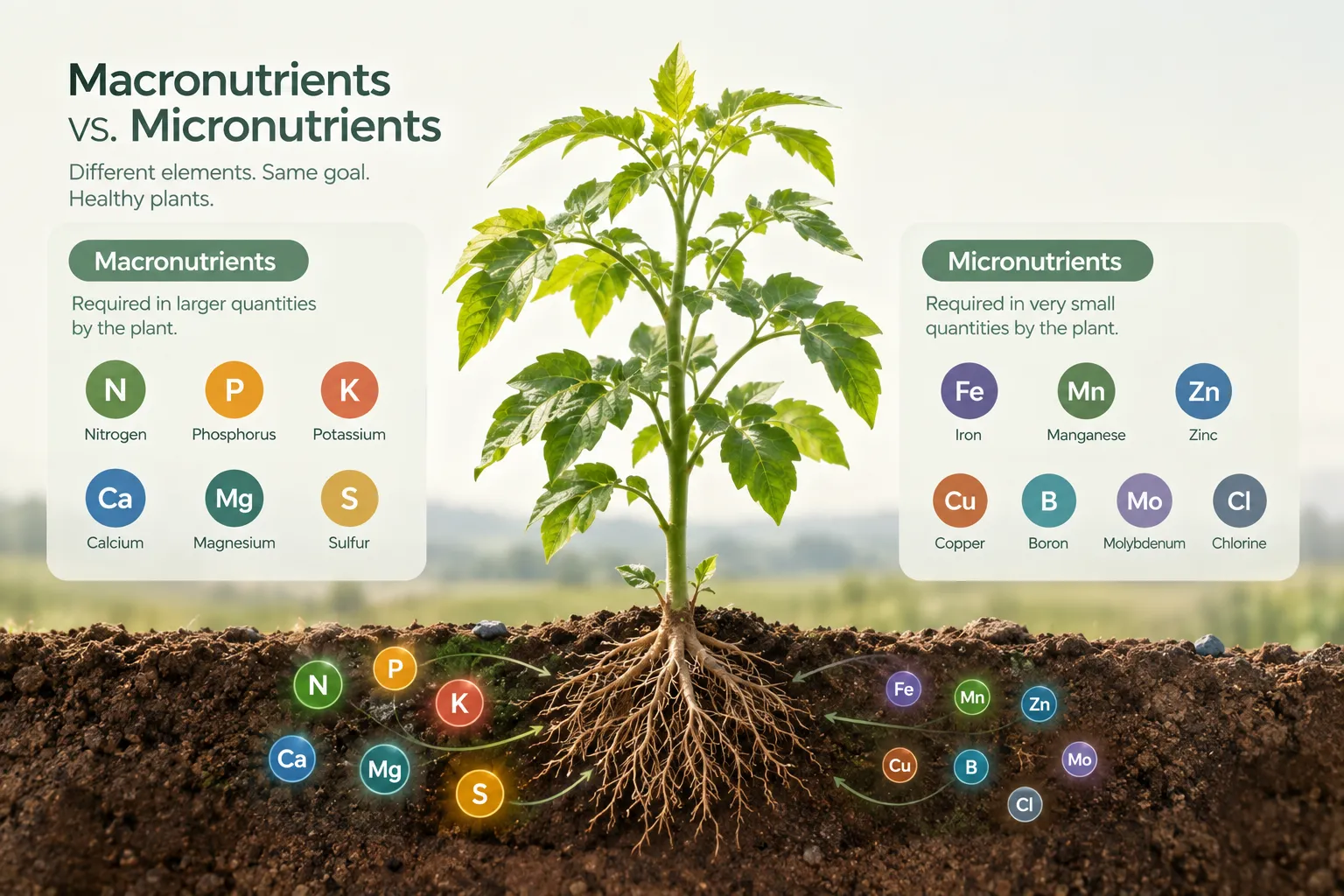
Macronutrients provide the materials and support that keep crop growth moving. Nitrogen supports green leaf area, proteins and canopy development. Phosphorus supports energy transfer and early root establishment. Potassium regulates water relations, enzyme activity and the movement of sugars that contribute to fruit, tuber and grain quality.
The secondary macronutrients are equally essential. Calcium strengthens cell walls and supports new tissues. Magnesium sits at the center of the chlorophyll molecule. Sulfur is part of amino acids and proteins.
| Group | Element | Symbol |
|---|---|---|
| Primary macronutrient | Nitrogen | N |
| Primary macronutrient | Phosphorus | P |
| Primary macronutrient | Potassium | K |
| Secondary macronutrient | Calcium | Ca |
| Secondary macronutrient | Magnesium | Mg |
| Secondary macronutrient | Sulfur | S |
Where do macronutrient symptoms appear?
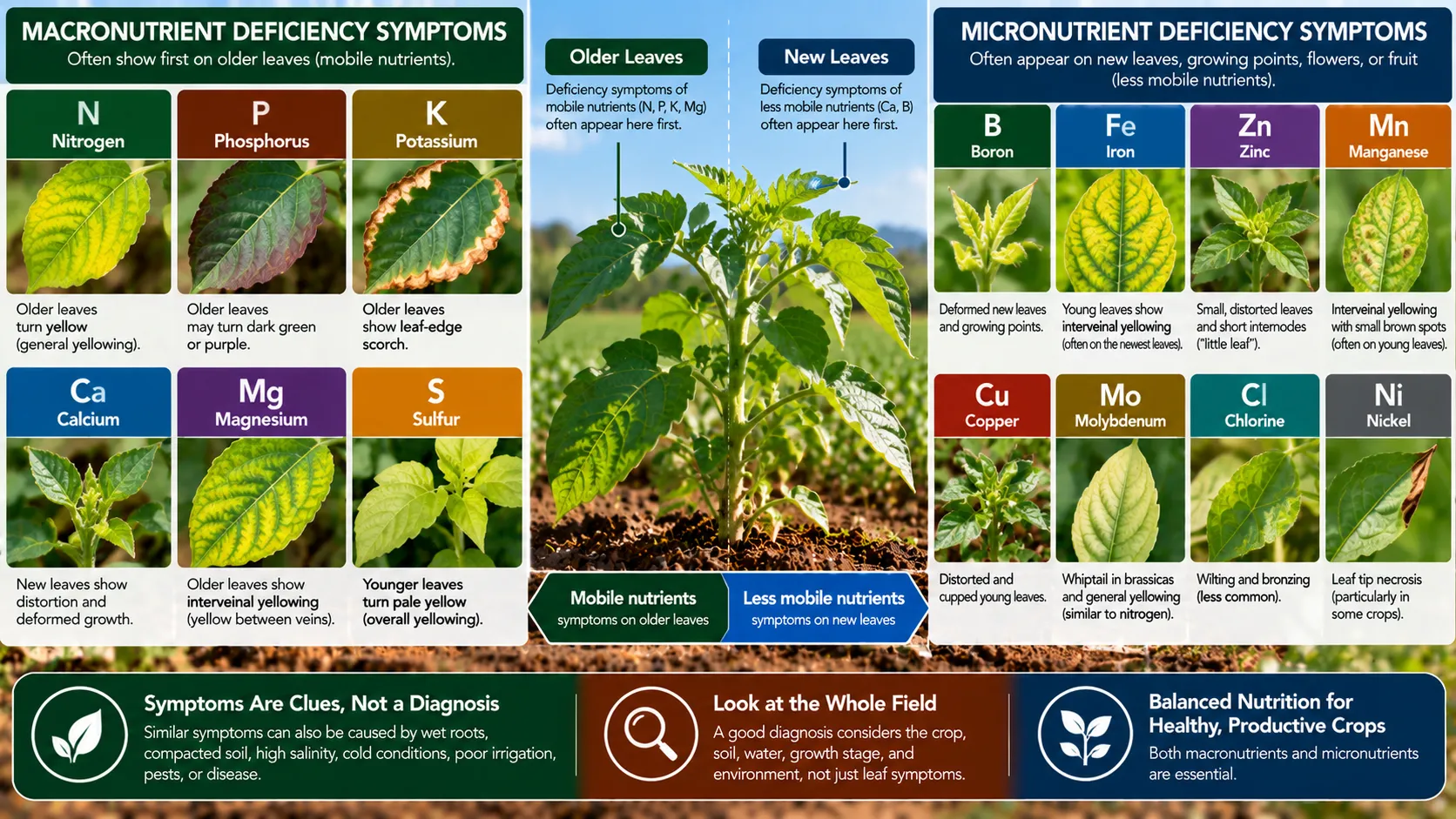
Mobility inside the plant offers a useful first clue. Nitrogen, phosphorus, potassium and magnesium can often move from older tissues toward younger growth, so shortages frequently appear first on older leaves. Examples include general yellowing with nitrogen, leaf-edge scorch with potassium and interveinal yellowing with magnesium.
Calcium does not move readily once deposited in plant tissue. Calcium-related disorders therefore tend to affect new growth, growing points or developing fruit. These patterns are clues, not proof.
Which nutrients are micronutrients?
Micronutrients keep essential reactions and developmental processes working. Iron and manganese contribute to chlorophyll formation and photosynthetic function. Zinc supports enzyme activity and normal leaf expansion. Boron contributes to cell-wall formation, pollen function and sugar movement. Molybdenum helps plants use nitrate nitrogen and is especially important in legumes and brassicas.
| Element | Symbol |
|---|---|
| Boron | B |
| Chlorine | Cl |
| Copper | Cu |
| Iron | Fe |
| Manganese | Mn |
| Molybdenum | Mo |
| Nickel | Ni |
| Zinc | Zn |
Micronutrient problems often result from poor availability rather than a complete absence from the field. High soil pH can restrict iron, manganese, zinc and copper. Boron can leach from light, sandy soils. Cold or saturated soil can slow root activity and make an otherwise adequate supply difficult to access.
Why must micronutrient correction be precise?
Because micronutrients are used at low rates, the margin between enough and too much can be narrow. Boron and copper require particular care. Base broad corrections on a representative tissue test, soil result or a well-established local risk pattern.
For foliar use, follow the product label, check tank-mix compatibility and avoid spraying stressed crops during hot or drying conditions. Never infer a safe rate from the nutrient name alone.
Why are visible symptoms not a diagnosis?
Similar leaf and fruit patterns can result from wet roots, compacted soil, high salinity, unsuitable pH, cold conditions, poor irrigation uniformity, pesticide injury, pests or disease. A sound diagnosis evaluates the whole field before selecting a product.
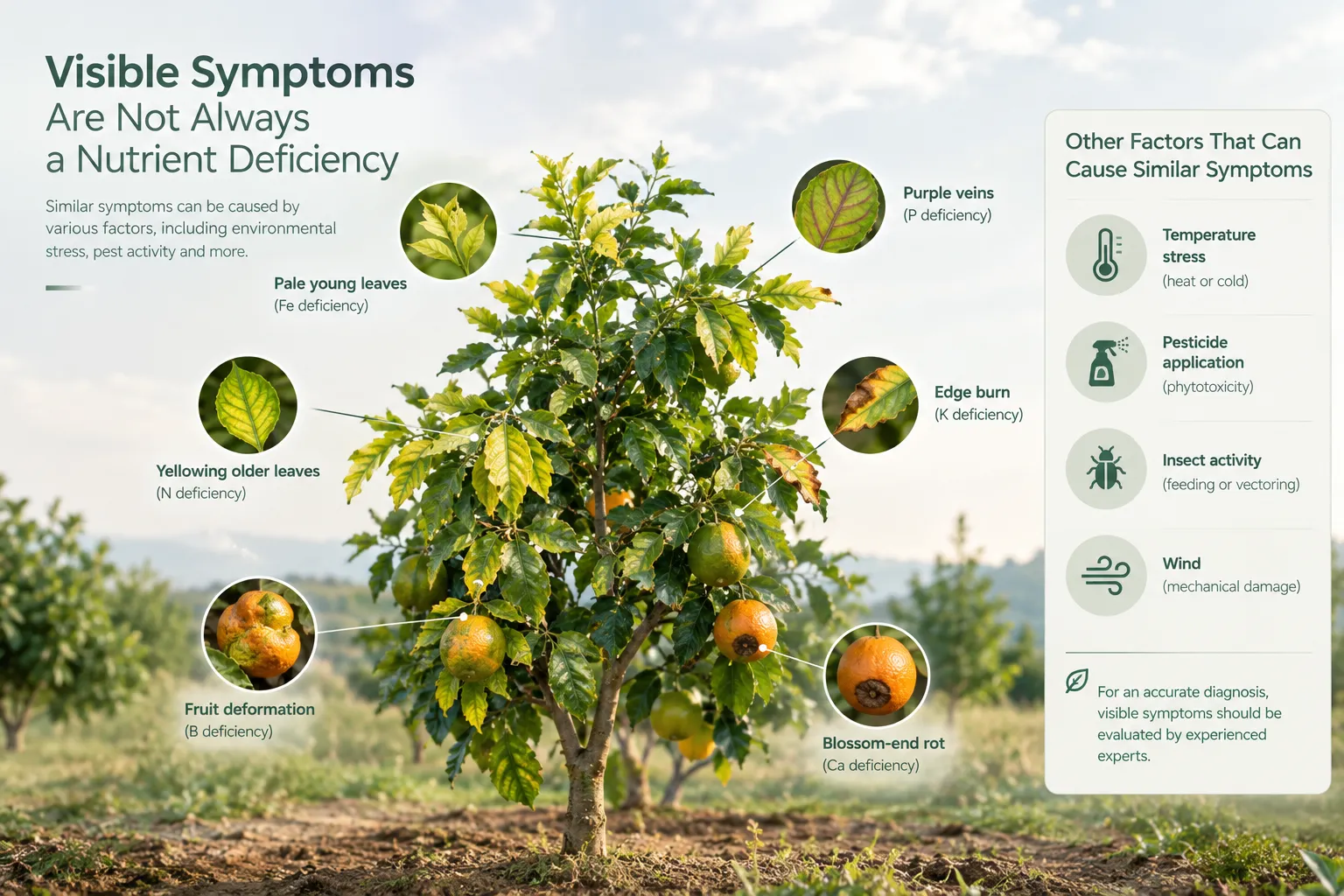
Use the field nutrient-deficiency diagnosis guide to combine spatial patterns, leaf age, root-zone inspection and comparative sampling.
What do fertilizer numbers mean?
Many fertilizer analyses are written as N-P2O5-K2O. A 20-20-20 grade means the product contains 20% nitrogen, 20% phosphate expressed as P2O5 and 20% potash expressed as K2O. This is a label convention, not a complete nutrition plan, and conventions can differ by market.
| Example grade | Where it may fit | What still needs checking |
|---|---|---|
| 20-20-20 + trace elements | A balanced soluble feed when crop demand and soil supply are broadly balanced | Water EC, alkalinity, crop stage and whether phosphorus or potassium is already high |
| 10-52-10 | Early establishment where additional phosphorus is justified | Soil phosphorus, pH and zinc status before repeating high-phosphorus applications |
| 12-12-36 + trace elements | Fruit, tuber or grain filling when potassium demand is rising | Magnesium balance and total root-zone salt load |
| 15.5-0-0 + 19% Ca | Compatible fertigation programs needing nitrate nitrogen and calcium | Water quality, compatibility and the full seasonal nitrogen budget |
These formulas are examples, not recommendations. Use the product label and local agronomic guidance to set source, rate, placement and timing.
How should growers diagnose a nutrient problem?
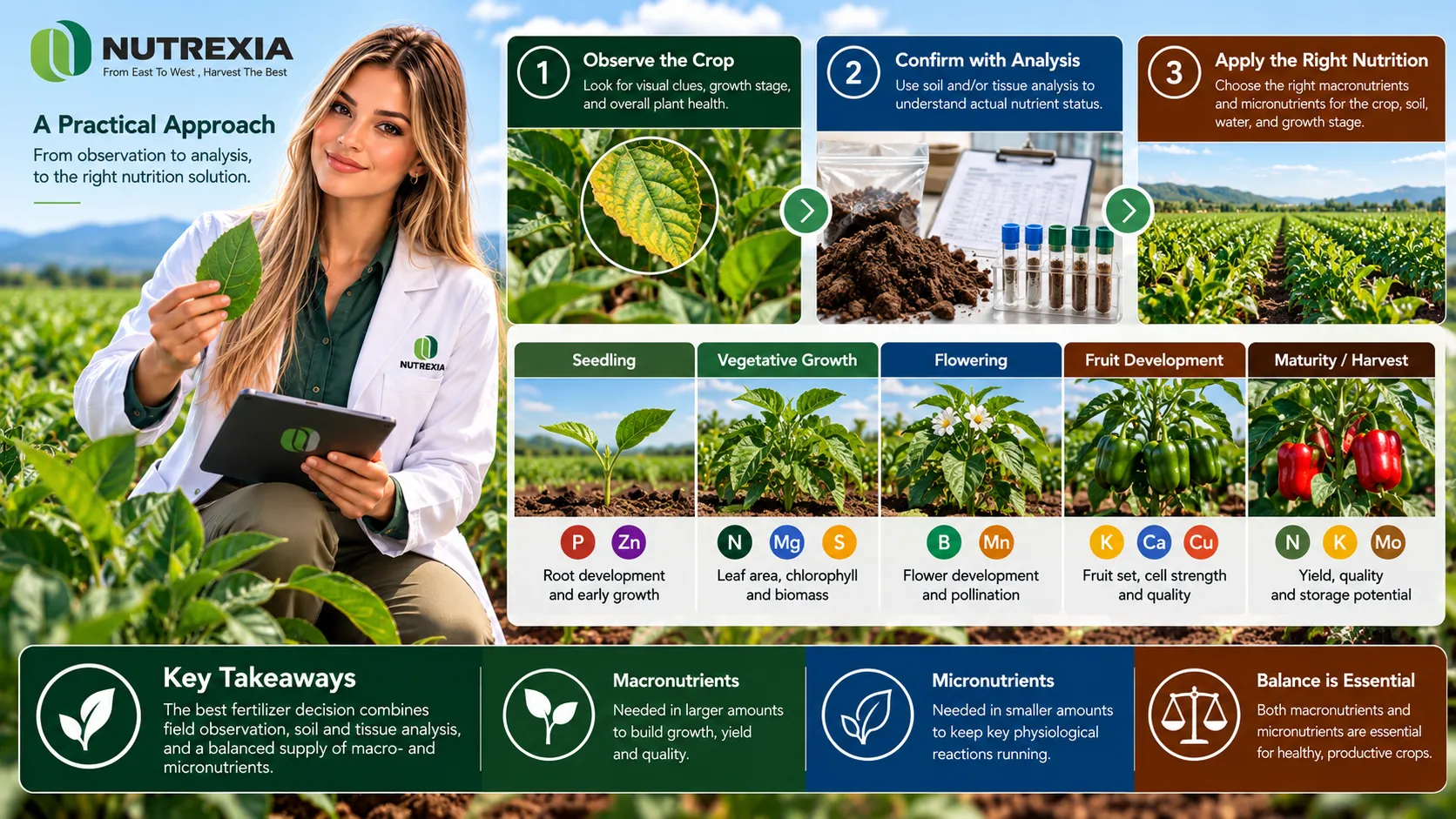
Start by walking the field and mapping the pattern. Is the problem uniform, limited to a wet area, following irrigation lines or concentrated on compacted headlands? A uniform pattern can point toward a broad nutrition or water issue; a patchy pattern often points toward roots, irrigation or soil variation.
Next, note whether symptoms begin on old or new leaves and inspect the root zone. Check moisture, drainage, EC or salinity, pH, soil temperature and root health. Review the product analysis, rate, application date, water volume and tank mix. Tissue results are most useful when paired with soil or water data and a clear record of crop growth stage.
- Use a representative sample, not one damaged plant.
- Compare a symptomatic area with a healthy area whenever possible.
- Correct the confirmed limitation first, then monitor the crop response.
- Record the outcome so the next program begins with better information.
Why does balanced nutrition matter throughout the season?
A strong nutrition plan is not one application or one “balanced” grade. Soil and water tests establish the baseline. Crop stage shows when demand is changing. Tissue testing and scouting show whether the program is being delivered as expected. Irrigation management helps determine whether nutrients can reach the roots.
Balance matters as much as supply. Excess potassium can make magnesium uptake harder. Excess phosphorus can reduce zinc availability in some conditions. Over-liming can make several micronutrients less available. These interactions are reasons to measure, observe and adjust with purpose rather than chase every nutrient.
Work with Nutrexia
Bring crop details, field history, growth stage, soil or water analysis and the current fertilizer program to a qualified adviser. Contact Nutrexia to discuss how field evidence can support a precise nutrition strategy for crop performance, input efficiency and harvest quality.
References
- Havlin, J. L., Tisdale, S. L., Nelson, W. L., and Beaton, J. D. Soil Fertility and Fertilizers. 8th ed. Pearson, 2014.
- Marschner, P. Marschner’s Mineral Nutrition of Higher Plants. 3rd ed. Academic Press, 2012.
- FAO. Plant Nutrition for Food Security: A Guide for Integrated Nutrient Management. Food and Agriculture Organization of the United Nations, 2006.
- Consult regional extension guidance for crop-specific tissue sufficiency ranges, fertilizer recommendations and registered product use.
Frequently asked questions
What is the main difference between macronutrients and micronutrients?
The difference is the quantity a plant requires, not the importance of the nutrient. Plants need macronutrients in comparatively large amounts and micronutrients in much smaller amounts, but a shortage of either group can limit growth, yield or quality.
Which elements are plant macronutrients?
The primary macronutrients are nitrogen, phosphorus and potassium. Calcium, magnesium and sulfur are commonly called secondary macronutrients.
Which elements are plant micronutrients?
Plant micronutrients include boron, chlorine, copper, iron, manganese, molybdenum, nickel and zinc. They are required in small quantities but support essential physiological and biochemical processes.
Can leaf symptoms prove which nutrient is deficient?
No. Leaf age and symptom patterns are useful clues, but wet roots, compaction, salinity, cold, irrigation problems, pests and disease can look similar. Confirm important decisions with field history and suitable soil, water or tissue analysis.
Does a balanced NPK fertilizer provide complete plant nutrition?
Not necessarily. An NPK grade reports selected nutrient percentages; it does not show what the soil, water and crop already supply or whether secondary nutrients and micronutrients are available. A complete program must account for crop demand and local conditions.
About the agronomist

Somayeh Soroush
Plant & Horticultural Expert · Nutrexia R&D Specialist
From productive gardens to advanced greenhouse systems, Somayeh Soroush works where practical horticulture meets modern plant nutrition. She supports progressive growers and greenhouse teams across the Middle East, translating Nutrexia's research into clear, field-ready guidance for diverse crops and growing conditions.
Reviewed by: Somayeh Soroush