Plant Nutrition Fundamentals
How to Read a Fertilizer Label
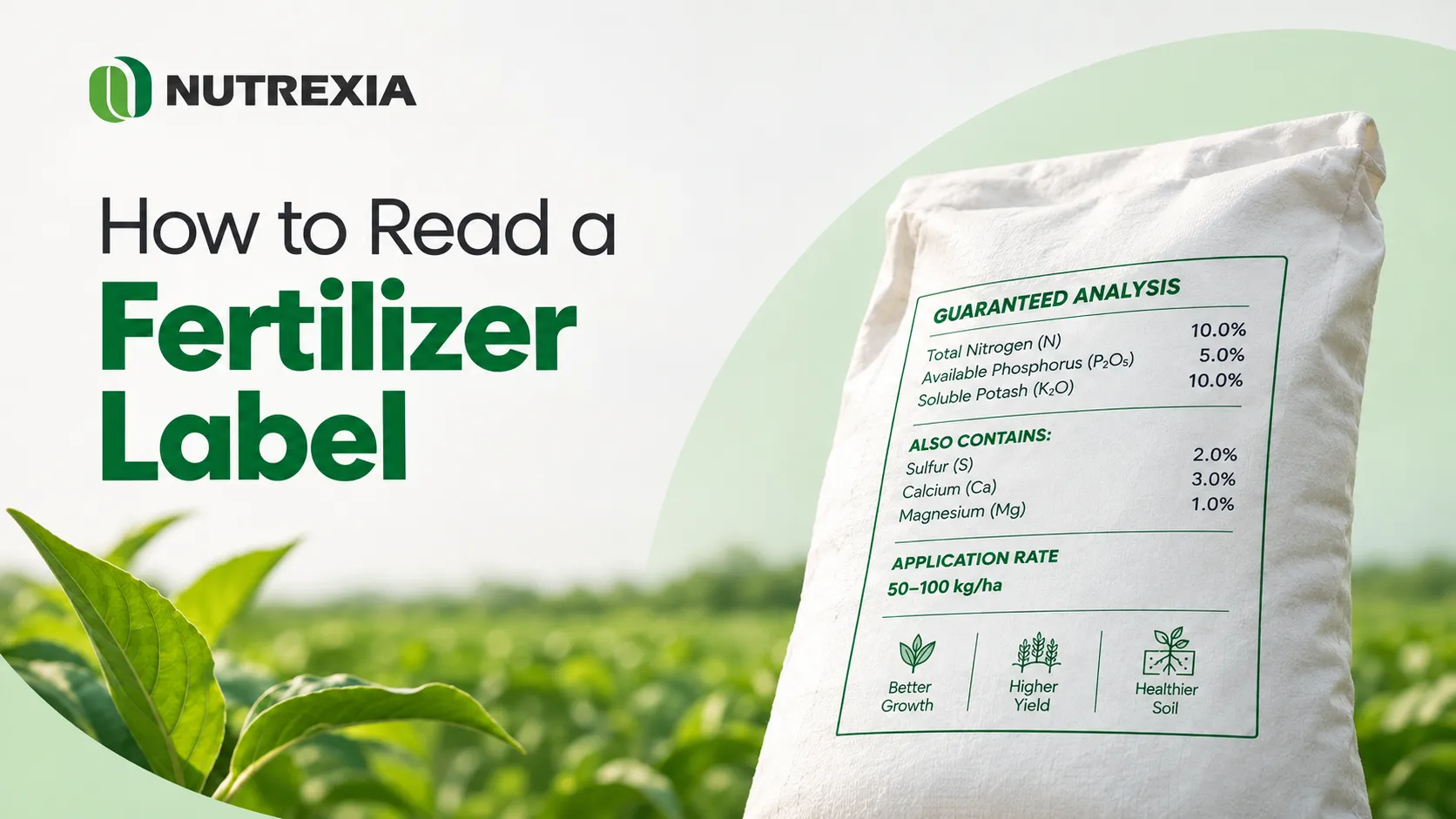
Read the guaranteed analysis, percentage basis, density, application rate, and directions together to understand what a fertilizer supplies and how much product to apply.
What should you check first on a fertilizer label?
Start with the complete guaranteed analysis, then confirm how each percentage is expressed, the recommended application rate and units, and the directions for use. For a liquid fertilizer, also check the stated density or specific gravity before converting between volume and mass.
A fertilizer label contains more than a product name and three N-P-K numbers. It tells you what nutrients the product guarantees, how those nutrients are expressed, how much product is recommended, and how the fertilizer is intended to be used. Reading these elements together helps you calculate what you are actually applying.
This guide explains general label-reading and calculation principles. Always follow the registered product label and applicable local guidance. Match the final fertilizer program to the crop, growth stage, soil or substrate, irrigation water, weather, equipment, and production system.
Start with the guaranteed analysis
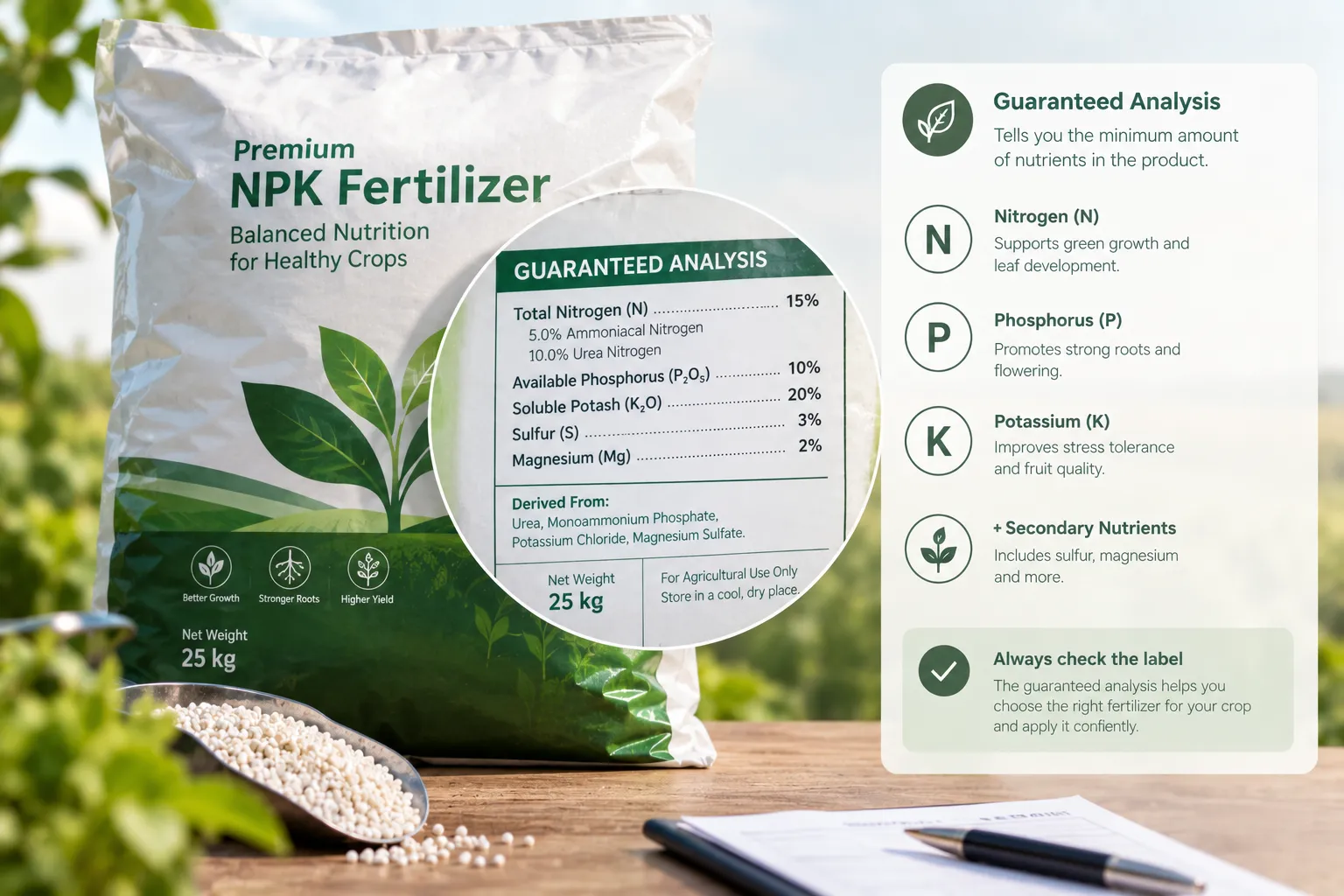
The guaranteed analysis is the core of the label. It lists the nutrients the product guarantees and their concentrations. Use it to decide whether the nutrient profile matches the crop’s needs; do not select a fertilizer from its product name alone.
For example, a product labeled 10% nitrogen on a weight-to-weight basis contains 10% nitrogen by mass. One kilogram of that product therefore contains 100 grams of nitrogen.
What do the N-P-K numbers mean?
The familiar N-P-K numbers refer to the primary nutrients nitrogen (N), phosphorus (P), and potassium (K), in the nutrient forms and conventions used on the label. These numbers are important, but they are not a complete description of the fertilizer.
A product may also guarantee secondary nutrients such as calcium, magnesium, or sulfur and micronutrients such as iron, zinc, manganese, boron, copper, and molybdenum. Read the entire analysis instead of relying only on the three prominent numbers on the front of the package.
The right fertilizer is not automatically the product with the highest percentage. The useful question is whether its complete nutrient profile, physical form, and application rate fit the crop and production system.
How are fertilizer percentages expressed?
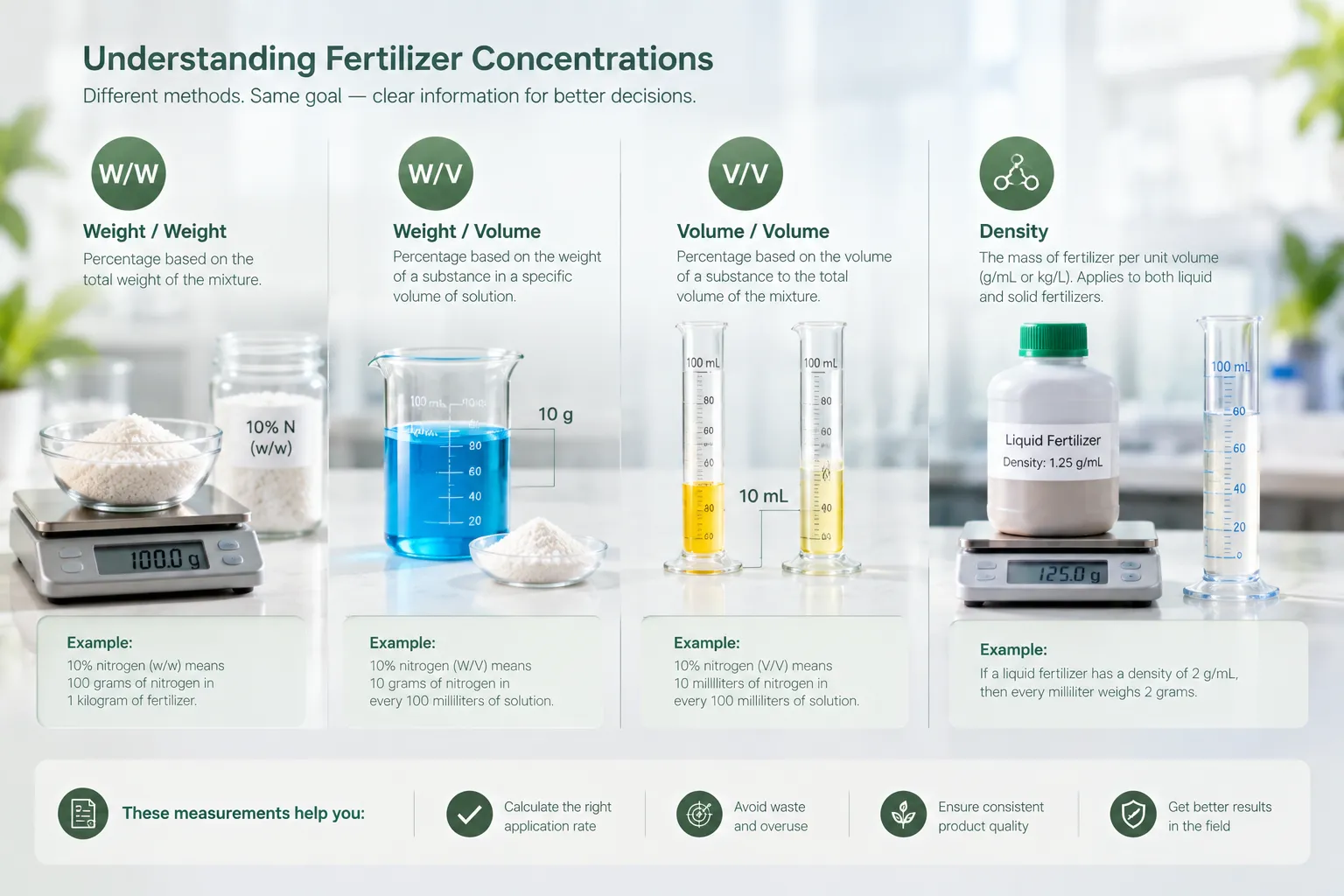
Before making a calculation, identify both the nutrient percentage and its basis. Percentages are commonly expressed as weight to weight (w/w). Liquid products may also use weight to volume (w/v) or, in some situations, volume to volume (v/v).
Weight to weight (w/w)
A w/w percentage expresses nutrient mass relative to the total mass of the fertilizer. A product containing 10% N (w/w) contains 10 grams of nitrogen per 100 grams of fertilizer, or 100 grams per kilogram of product.
Weight to volume (w/v)
A w/v percentage expresses nutrient mass relative to product volume. For example, 10% N (w/v) means 10 grams of nitrogen in every 100 milliliters of product.
Volume to volume (v/v)
A v/v percentage expresses the volume of one component relative to the total volume of the mixture. Check exactly what the label defines as the component and reference volume before using the percentage.
These bases are not interchangeable. The basis determines how the concentration must be interpreted in an application calculation.
Why do density and specific gravity matter for liquids?
Density is mass per unit volume, commonly stated as grams per milliliter (g/mL) or kilograms per liter (kg/L). It matters when a liquid product is handled by volume while its nutrient content or application recommendation is expressed by mass.
If a liquid fertilizer has a density of 1.20 kg/L, one liter weighs 1.20 kilograms. Use this value to convert between the volume measured by the equipment and the mass used in the analysis or recommendation.
Specific gravity is the ratio of the product’s density to the density of water under stated reference conditions. It also helps with mass-to-volume conversions. Never assume that one liter of fertilizer always weighs one kilogram; use the product’s stated specification.
How do you read the application rate?
The application rate states how much product should be applied to a defined area. Common units include kilograms per hectare (kg/ha), liters per hectare (L/ha), and grams per square meter (g/m²).
Keep the product quantity and area in compatible units before calculating. One hectare equals 10,000 square meters.
Convert the label rate to the field area
Suppose a granular fertilizer is recommended at 200 kg/ha:
- For a 0.5-hectare field:
200 kg/ha × 0.5 ha = 100 kgof product. - For a 1,000 m² area:
1,000 m² ÷ 10,000 = 0.1 ha, then200 kg/ha × 0.1 ha = 20 kgof product.
First convert the actual area to the same area unit used by the recommendation. Then multiply the rate by that area.
Calculate the nutrient applied
Product rate and nutrient rate are different. For a nutrient expressed on a w/w basis:
Nutrient applied = product applied × nutrient fraction
Applying 200 kg/ha of a fertilizer containing 10% N supplies:
200 kg/ha × 0.10 = 20 kg N/ha
This calculation allows meaningful comparisons between products. A lower nutrient percentage can still deliver the required nutrient amount at a different product rate, provided the rate and use follow the label and agronomic recommendation.
Why does application timing matter?
The correct fertilizer applied at the wrong time may not produce the expected result. Timing depends on crop type, growth stage, root activity, soil or substrate conditions, irrigation, weather, and fertilizer form.
Read the label directions together with the crop’s nutritional demand and the full fertilizer program. Treat timing, placement, concentration, and method as parts of the application decision.
A practical fertilizer-label checklist
- Identify the product and its intended use.
- Read the complete guaranteed analysis.
- Confirm whether each percentage is w/w, w/v, or v/v.
- Review secondary nutrients and micronutrients, not only N-P-K.
- For liquids, check density or specific gravity before converting mass and volume.
- Read the application rate, area basis, and units.
- Convert the rate to the actual field, greenhouse, orchard, or plot area.
- Calculate the amount of each important nutrient supplied.
- Check crop stage, timing, soil or growing conditions, equipment, and label directions before applying.
Common fertilizer-label mistakes
- Looking only at N-P-K: The three primary nutrient numbers do not describe the complete product.
- Ignoring the percentage basis: A percentage means different things depending on whether it is w/w, w/v, or v/v.
- Assuming one liter equals one kilogram: Liquid density varies by product.
- Confusing product rate with nutrient rate: Applying 200 kg/ha of product does not mean applying 200 kg/ha of nitrogen.
- Mixing area or quantity units: Convert hectares, square meters, kilograms, liters, and grams before comparing or calculating.
- Treating the label as the whole nutrition plan: The label explains the product; the plan must also account for the crop and growing conditions.
How should two fertilizers be compared?
Do not compare only the largest number on the package. Compare the complete guaranteed analysis, percentage basis, nutrient profile, product form, recommended application rate, and—where relevant—density and specific gravity.
Ask: Which product delivers the nutrient combination the crop needs, at an appropriate rate and in a form suited to the production system?
Use the label as the starting point
A fertilizer label provides the product’s guaranteed composition and directions for use. Good fertilizer management connects that information with crop requirements, soil or substrate conditions, irrigation water, growth stage, and the rest of the nutrient program.
The objective is not simply to apply fertilizer. It is to know what product is being applied, how much nutrient it supplies, and why that amount and timing fit the crop. Explore Nutrexia fertilizer solutions or contact the Nutrexia team to discuss a crop- and market-specific approach.
Frequently asked questions
What is the most important part of a fertilizer label?
Start with the complete guaranteed analysis. It identifies the nutrients the product guarantees and their concentrations. Then check the percentage basis, application rate, directions, and any density or specific-gravity information needed for liquid products.
What do the three NPK numbers mean?
They represent the guaranteed amounts of the primary nutrients nitrogen, phosphorus, and potassium in the forms and units defined by the label. They are only part of the analysis; secondary nutrients and micronutrients may also be listed.
Does one liter of liquid fertilizer weigh one kilogram?
Not necessarily. Liquid fertilizers have different densities. Use the density or specific gravity stated for the product when converting between volume and mass.
How is nutrient application calculated for a w/w analysis?
Multiply the product application rate by the nutrient fraction. For example, 200 kg/ha of a product containing 10% nitrogen supplies 20 kg N/ha.
Is the fertilizer label a complete crop nutrition plan?
No. The label describes the product and its directions. A crop nutrition plan must also consider crop demand, growth stage, soil or substrate conditions, irrigation water, weather, and local recommendations.
About the agronomist

Somayeh Soroush
Plant & Horticultural Expert · Nutrexia R&D Specialist
From productive gardens to advanced greenhouse systems, Somayeh Soroush works where practical horticulture meets modern plant nutrition. She supports progressive growers and greenhouse teams across the Middle East, translating Nutrexia's research into clear, field-ready guidance for diverse crops and growing conditions.
Reviewed by: Somayeh Soroush