Plant Nutrition Fundamentals
Why Phosphorus Gets Fixed in Soil—and What to Do
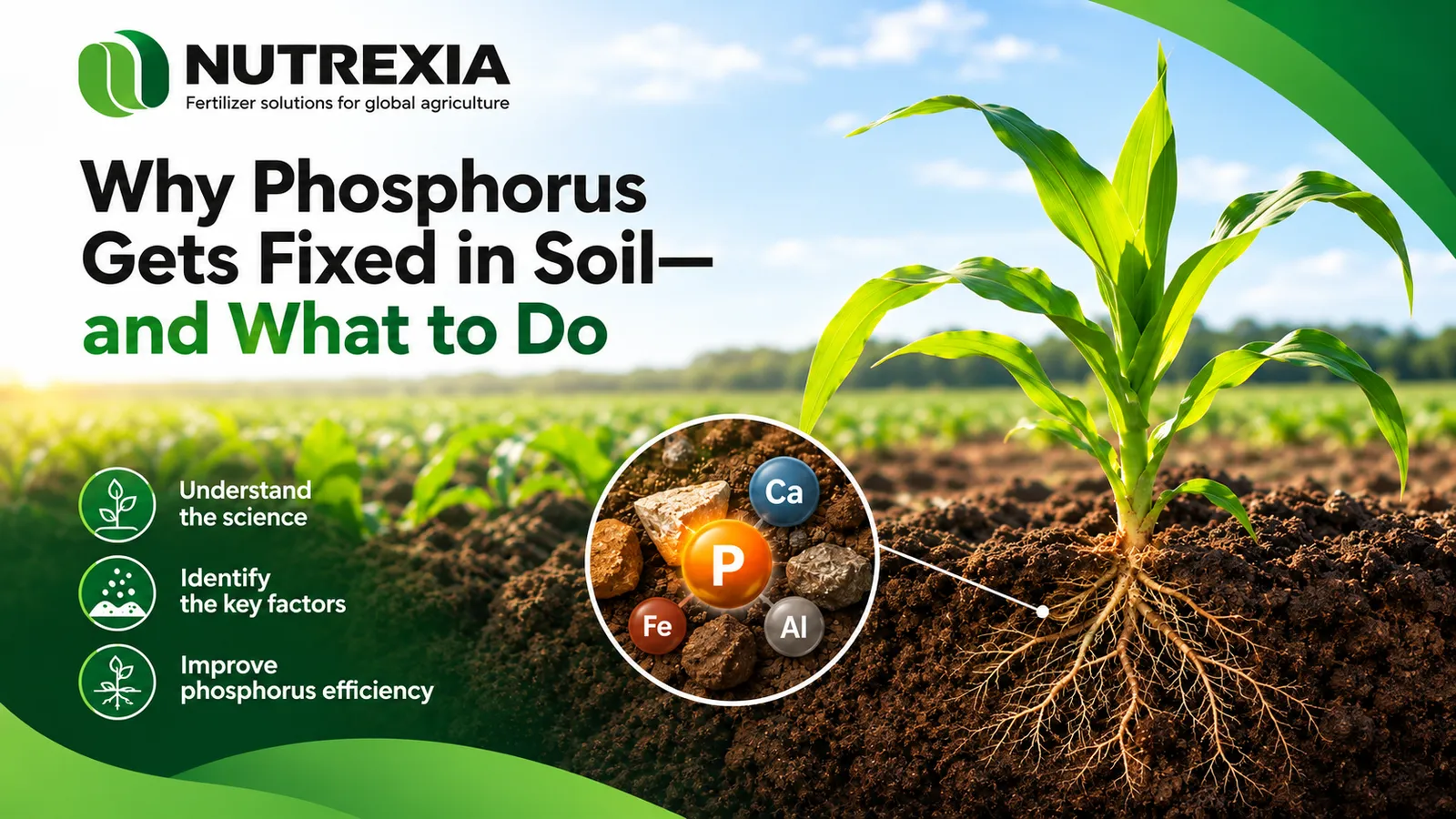
Phosphorus can be present in soil yet remain difficult for roots to access because it reacts with iron and aluminum in acidic soils, calcium in high-pH soils, and mineral surfaces. Soil testing, pH management, targeted placement, and strong root growth can improve phosphorus-use efficiency.
Why can phosphorus be present in soil but unavailable to plants?
Phosphorus can be present in soil while the amount immediately available to roots remains low. Plants absorb phosphorus mainly as phosphate ions from the soil solution, but this available pool is small and must be replenished as roots remove phosphorus. At the same time, phosphate reacts readily with soil minerals and surfaces, so some of it moves into less-soluble or more strongly held forms.
In acidic soils, iron and aluminum reactions are especially important. In calcareous and high-pH soils, calcium-phosphate reactions become more important. Clay mineralogy, organic matter, moisture, temperature, root activity, fertilizer placement, and the existing soil phosphorus level also influence availability. The practical goal is therefore not simply to apply phosphorus, but to keep an adequate supply accessible to active roots when the crop needs it.
This guide explains general soil-phosphorus principles. Exact rates, sources, placement, and pH amendments must be based on a calibrated soil test, crop requirements, local recommendations, and product instructions.
What does phosphorus fixation actually mean?
Phosphorus fixation is a practical term for soil reactions that reduce the amount of phosphate in the readily available soil-solution pool. Phosphate may precipitate with other elements, become strongly sorbed to mineral surfaces, or move into compounds that dissolve too slowly to meet immediate crop demand.
Fixed phosphorus has not necessarily disappeared permanently. Some forms can return to more available pools, but release may be too slow during periods of high crop demand. This is why a soil can contain substantial total phosphorus while a crop still responds to better phosphorus management.
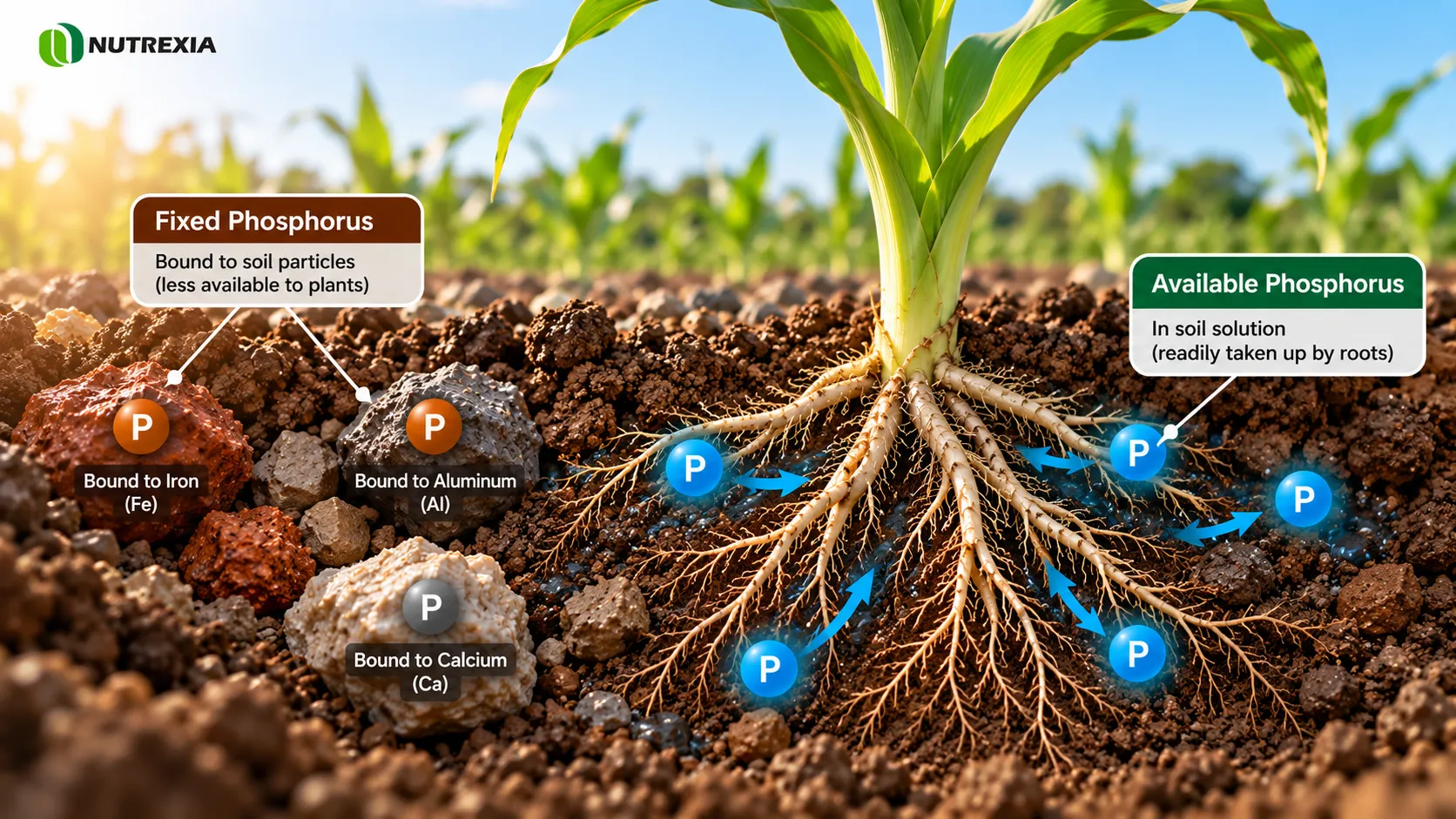
The USDA National Agronomy Manual explains that plants take up the orthophosphate ions H₂PO₄⁻ and HPO₄²⁻, while soil pH strongly influences which form predominates and which phosphorus-bearing minerals develop.
How does soil pH affect phosphorus availability?
Soil pH changes the chemical environment around phosphate. Phosphorus is generally most available across a moderately acidic to neutral range, often around pH 6 to 7, although the most appropriate target depends on the crop and soil.
Acidic soils: iron and aluminum
In strongly acidic soils, phosphorus can react with iron and aluminum compounds and can also be held strongly on oxide and clay surfaces. These reactions reduce the amount of phosphate remaining in solution for root uptake.
Where a soil test confirms that acidity is limiting crop performance, an appropriate liming program may improve the root environment and phosphorus availability. Liming decisions must follow local recommendations because amendment needs depend on more than the measured pH alone.
Calcareous and high-pH soils: calcium
In calcareous and high-pH soils, phosphorus can react with calcium. Calcium-phosphate compounds may gradually develop into more stable and less-soluble forms. Management should focus on soil-test interpretation, suitable placement, timing, and crop demand rather than assuming that a larger application will remain available.
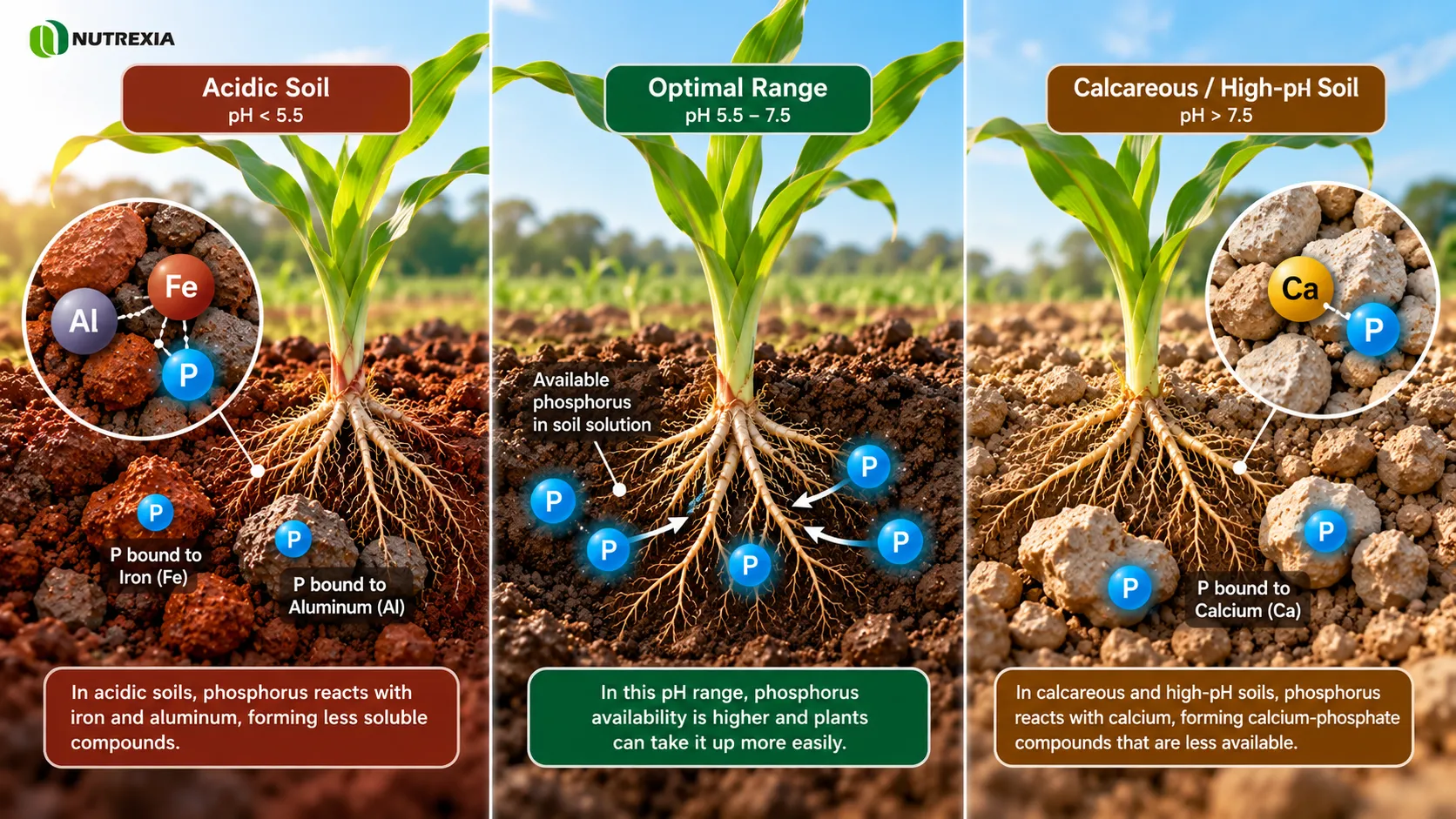
The University of Minnesota Extension describes aluminum-bound phosphorus as an important concern around pH 4.8–5.5 and calcium-bound phosphorus as a concern above about pH 7.3. These thresholds are useful guides, not universal field prescriptions.
What else controls phosphorus availability and uptake?
Soil pH is important, but it does not act alone. Several conditions affect how readily phosphorus reaches active roots:
- Clay content and mineralogy: Some clay and oxide surfaces can sorb phosphate strongly.
- Calcium, iron, and aluminum: Their abundance and chemical form influence which phosphorus compounds develop.
- Organic matter and biological activity: Organic phosphorus must be mineralized before plants can use it, while organic compounds can also influence sorption and nutrient cycling.
- Soil moisture and aeration: Dry soil slows phosphate diffusion toward roots; saturated or poorly aerated conditions can restrict root activity.
- Soil temperature: Cool conditions slow root growth and biological activity, which can reduce early-season uptake.
- Root development: Because phosphorus moves only short distances in most soils, active roots need to explore the fertilized soil volume.
- Placement and concentration: Fertilizer position affects how much applied phosphorus contacts soil and how easily young roots encounter it.
These factors help explain why phosphorus-related symptoms do not always mean that the soil contains too little total phosphorus. The limitation may involve availability, root access, or root activity.
Why is adding more phosphorus not always the answer?
Applying more phosphorus without diagnosing the limiting factor can be inefficient. Where soil conditions favor strong sorption or precipitation, a larger application may increase the amount entering less-available pools rather than producing a proportional increase in crop uptake.
First-season recovery of fertilizer phosphorus is often limited and varies widely with soil, crop, weather, placement, and the method used to calculate recovery. Residual phosphorus can still contribute to later crops, so a low first-season recovery figure does not mean that all remaining fertilizer phosphorus is permanently lost.
Repeated applications above crop need can also increase the risk of phosphorus movement to surface water through erosion or runoff. A calibrated soil test and a realistic crop-removal plan are therefore essential parts of both nutrient efficiency and environmental stewardship.
How can farmers improve phosphorus-use efficiency?
1. Start with representative soil testing
Use the soil-test method recommended for the soil pH and region, sample at the correct depth, and interpret the result with local calibration data. The test should guide both the need for phosphorus and any pH amendment.
2. Place phosphorus where active roots can reach it
Because phosphorus has limited mobility, targeted or banded placement can reduce soil contact and improve early root access in situations where local recommendations support it. Keep fertilizer a safe distance from seed and young tissue according to the product label and crop guidance.
3. Match the source and timing to the system
Select a phosphorus source that fits the soil, crop, irrigation system, equipment, and application method. Water solubility, accompanying nutrients, compatibility, and placement matter; liquid form alone does not make a phosphorus source more efficient than a dry product with similar chemistry.
4. Manage limiting soil acidity or alkalinity
Correcting an unsuitable pH can improve the root environment and nutrient availability, but soil amendments should follow a tested recommendation. It is rarely practical to change the pH of a highly calcareous field soil quickly or uniformly, so placement and crop-specific management remain important there.
5. Maintain organic matter and biological activity
Organic matter participates in phosphorus cycling and supports soil structure and biological activity. Its value is long-term and system-wide; it should not be treated as an immediate substitute for a diagnosed phosphorus requirement.
6. Support healthy root growth
Manage compaction, drainage, moisture, salinity, and other stresses that restrict the root system. A larger, active root network explores more soil and improves the crop’s opportunity to intercept phosphorus.
7. Avoid excessive rates
Base applications on soil-test results, crop need, yield goals, previous inputs, and local nutrient-management guidance. More fertilizer does not guarantee more uptake.
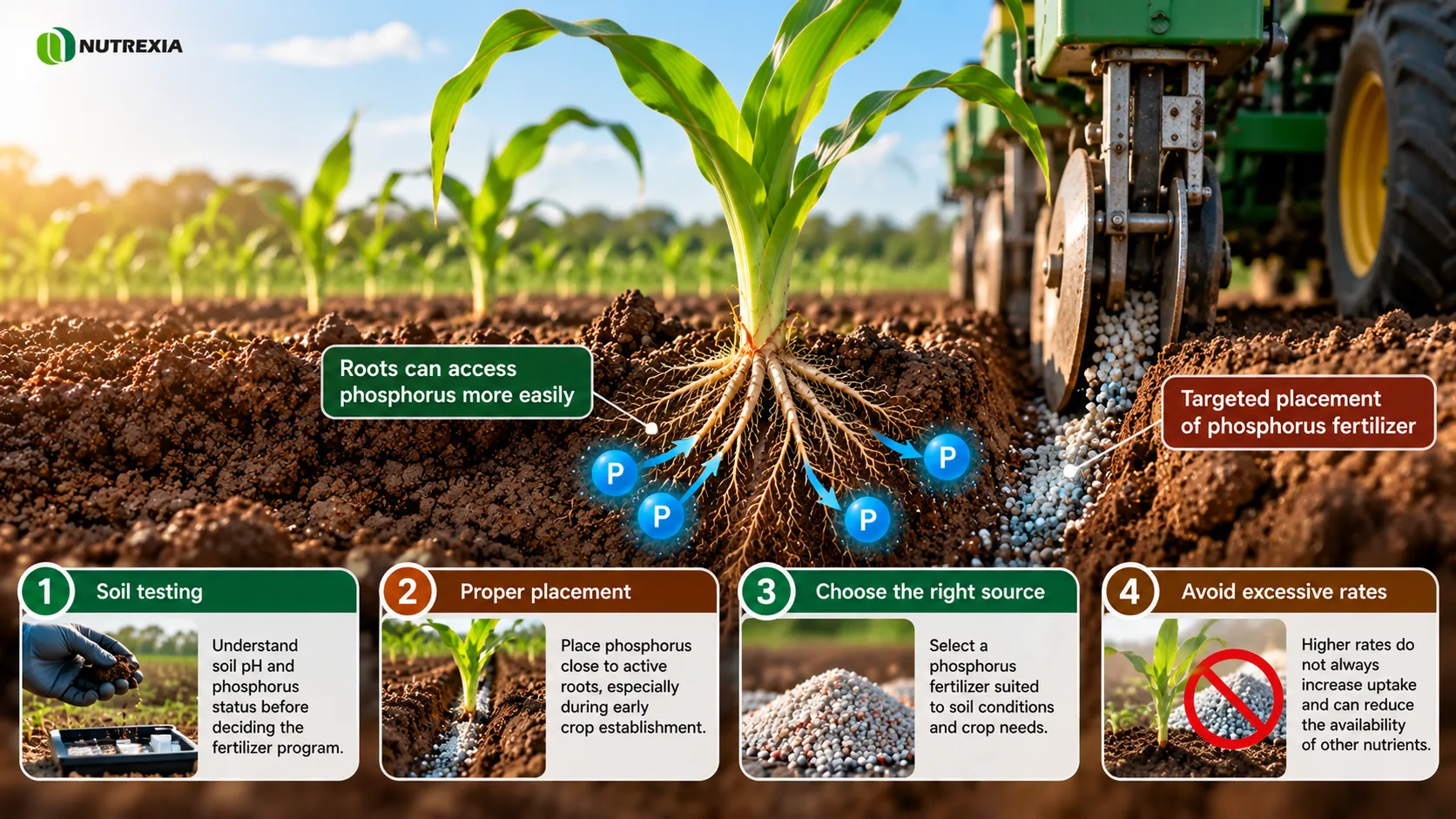
Penn State Extension likewise emphasizes soil testing, crop and soil characteristics, placement, root growth, and management of runoff and erosion when planning phosphorus applications.
Can foliar phosphorus replace soil-applied phosphorus?
Foliar phosphorus may complement a crop-nutrition program in specific situations, but it should not automatically replace root-zone phosphorus management. Leaves can absorb some nutrients, yet the quantities of macronutrients that can be applied safely and effectively through foliage are limited.
Use foliar phosphorus only where the crop, growth stage, formulation, water quality, concentration, and label support the practice. Diagnose the underlying soil or root-zone limitation rather than relying on repeated foliar applications to compensate for an unsuitable phosphorus program. Utah State University Extension advises treating foliar feeding as a supplement rather than the main source of macronutrients.
Phosphorus-management field checklist
When phosphorus performance is weaker than expected, review three groups of evidence.
Soil
- Soil pH and amendment requirement
- Plant-available phosphorus from the locally recommended test
- Calcium or lime status in calcareous soil
- Iron and aluminum conditions in acidic soil
- Clay content and mineralogy
- Organic matter, compaction, drainage, and aeration
Crop and roots
- Root distribution and activity
- Soil temperature and moisture
- Signs of compaction, salinity, disease, or oxygen stress
- Crop stage and expected phosphorus demand
- Tissue analysis where locally validated and appropriate
Fertilizer program
- Source and water solubility
- Placement relative to seed and active roots
- Timing and split strategy, where appropriate
- Rate in relation to soil test and crop need
- Previous phosphorus applications and manure inputs
- Runoff and erosion risk
This review helps distinguish a phosphorus-supply problem from an availability or root-uptake problem.
Make phosphorus available, not just applied
Effective phosphorus management starts with understanding what happens after fertilizer reaches the soil. Phosphorus may react with iron and aluminum in acidic soils, calcium in high-pH soils, or mineral surfaces across a wide range of conditions. Moisture, temperature, organic matter, placement, and root development then influence whether the crop can access the available pool.
The best response is not automatically a higher rate. Test the soil, identify the limiting condition, keep phosphorus close enough to active roots, select a suitable source and method, and monitor crop response. Contact Nutrexia to discuss a phosphorus nutrition program suited to your crop, soil, irrigation, and production goals.
Agronomy references
- USDA Natural Resources Conservation Service. National Agronomy Manual, Part 503: Crop Production.
- University of Minnesota Extension. Understanding phosphorus in Minnesota soils.
- Penn State Extension. Managing Phosphorus for Crop Production.
- Utah State University Extension. Nutrient Management.
Frequently asked questions
What does phosphorus fixation mean?
Phosphorus fixation describes reactions that remove phosphate from the readily available soil-solution pool and hold it in less-soluble or strongly sorbed forms. The phosphorus remains in the soil, but roots may not be able to access it quickly enough to meet crop demand.
Why is phosphorus less available in acidic soil?
In strongly acidic soils, phosphorus can react with iron and aluminum compounds or bind strongly to mineral surfaces. These reactions reduce the concentration of phosphate that remains readily available in the soil solution.
Why is phosphorus less available in calcareous or high-pH soil?
In calcareous and high-pH soils, phosphorus can react with calcium and gradually form less-soluble calcium-phosphate compounds. Source, placement, timing, soil-test results, and crop demand should therefore guide the fertilizer program.
Does applying more phosphorus solve phosphorus fixation?
Not automatically. Where soil conditions favor fixation, a larger application may add more phosphorus to less-available pools without producing a proportional increase in crop uptake. Use calibrated soil testing and crop-specific recommendations to choose the rate and method.
Can foliar phosphorus replace soil-applied phosphorus?
Usually not. Foliar phosphorus may complement a crop-nutrition program in specific situations, but leaves can receive only limited quantities safely. Most crop phosphorus demand must still be supplied through an effective root-zone program.
About the agronomist

Somayeh Soroush
Plant & Horticultural Expert · Nutrexia R&D Specialist
From productive gardens to advanced greenhouse systems, Somayeh Soroush works where practical horticulture meets modern plant nutrition. She supports progressive growers and greenhouse teams across the Middle East, translating Nutrexia's research into clear, field-ready guidance for diverse crops and growing conditions.
Reviewed by: Somayeh Soroush